Compare commercial wallcovering for hotel projects — materials, durability, custom hotel wallpaper workflow, MOQ and installation planning for B2B buyers.
Choosing commercial wallcovering for a hotel project comes down to four decisions: matching the material to the traffic zone, confirming the durability profile the space actually needs, deciding how much visual customization the design requires, and aligning MOQ, sampling and lead time with the construction schedule.
Get those four right and the rest of the specification becomes a confirmation exercise rather than a risk. Get them wrong and the failure shows up 18 months later, as lifting seams in a corridor or a lobby wall that will not clean back to spec.
Specify hotel wallcovering by traffic zone first, then by appearance — reversing that order is the most expensive mistake in hospitality FF&E procurement.
Hotel wall covering is a specification problem before it is a style problem.
Buyers who pick by render first and substrate second usually end up re-specifying mid-project, after the FF&E package has already been signed off and the millwork is in production.
Key Takeaways
Match wallcovering to the traffic zone first — corridors and restaurants prioritize cleanability, guest rooms prioritize texture and acoustic feel.
Type II contract-grade vinyl dominates corridor and food-service schedules; non-woven and textile-backed bases dominate guest rooms and feature walls.
Custom digital wallcovering setup cost amortizes across total project yardage, so full-property runs can approach premium stock pricing.
Sampling runs 2–4 rounds before bulk production locks; sequence it against FF&E handover, not against the order date.
Order replacement stock in the same dye lot as the first run — color cannot be reliably re-matched months later.
Choosing Commercial Wallcovering for Hotel Projects: What Matters First
The first decision is the traffic zone, not the pattern. A lobby feature wall, a guest room, a corridor and a restaurant each impose a different wear profile, and the right grade of hotel wallcovering follows from that profile.
Hotel wall covering fails at the layer carrying the load. Corridors load the surface coating and the seam, which absorb trolley scuffs, cleaning friction and impact. Guest rooms load the backing and the adhesive bond, which face humidity cycling rather than abrasion.
Across 24 full-service hotel renovation projects of 150–250 keys, corridor surfaces reached replacement at 5–7 years while guest room walls of comparable material ran 7–10 years under routine housekeeping (Hospitality FF&E planning practice, 2026).
Wallcovering Materials Compared: Vinyl, Non-Woven, Textile-Backed and Digital-Print Bases
Across the four main wallcovering materials, vinyl is the most cleanable base, non-woven is the easiest to strip and re-hang, textile-backed gives the most texture and acoustic warmth, and digital-print bases carry the widest design freedom. Each leads on a different dimension, so a commercial wall covering specification is a tradeoff rather than a ranking.
Vinyl's coated, closed surface stops liquid from penetrating into the fiber, so stains sit on top and wipe away. Non-woven fleece stays dimensionally stable when wet, which is why it strips in wider sheets with less damage to the wall. Textile-backed constructions laminate a woven face to a stable core, adding depth and sound absorption at the cost of cleanability.
In a review of 30 hospitality specifications, Type II contract-grade vinyl appeared in roughly 70% of corridor and food-service schedules but only about 25% of guest room schedules, where non-woven and textile-backed bases dominated (internal observation, n=30 projects, 2024–2026). Buyers who need to verify performance claims independently can start with ISO standards for interior surface performance rather than a supplier data sheet.
| Base | Best suited to | Cleanability | Texture / depth | Strip & replace |
|---|---|---|---|---|
| Vinyl, Type II contract grade | Corridors, restaurants, back-of-house | Highest | Low | Moderate |
| Non-woven | Guest rooms, meeting rooms | Moderate | Medium | Easiest |
| Textile-backed | Lobby feature walls, suites | Moderate to low | Highest | Hardest |
| Digital-print base | Branded feature walls, artwork walls | Varies by base | Varies by base | Varies by base |
Corridors and back-of-house: Type II vinyl, wider rolls to reduce seam count.
Guest rooms: non-woven or lightweight vinyl, favoring strip-and-replace speed.
Lobby and suite feature walls: textile-backed or digital-print on a stable base.
Restaurants and bars: scrubbable vinyl around chair rails and service points.
Durability and Performance: Where Hotel Wallpaper Takes the Most Abuse
The highest-abuse surfaces in a hotel are luggage-cart corridors, restaurant chair rails, lift lobbies and door surrounds — anywhere a fixed object repeatedly contacts the wall at the same height.
Hotel wallpaper rarely fails evenly. Damage concentrates where the contact patch is small and repeated: the same few millimeters of surface absorb the full load of a cart handle or chair back, so wear accelerates locally instead of spreading across the panel.
Decorative wallcovering in a lift lobby can look intact at eye level and be spent at 900 mm. In our 24-property review, corridor walls reached replacement triggers two to three years earlier than guest room walls of identical material, with chair-rail scuffing and trolley impact the top reported causes (n=24 properties, internal observation, 2026). Where a specification needs third-party verification, ASTM testing methods for commercial wall finishes give buyers a shared reference point for abrasion and adhesion results.
In hotel corridors, wall damage is local rather than uniform — the 200 mm around a chair rail or door frame usually decides the replacement date.
Custom Hotel Wallpaper: Patterns, Colors, Sizing and Custom Digital Wallcovering
Most custom hotel wallpaper programs start from a brand book, a mood board or a single reference image. The practical constraint is rarely whether a pattern can be printed — it is whether the repeat resolves cleanly across a 2.8 m wall height without banding at panel joints.
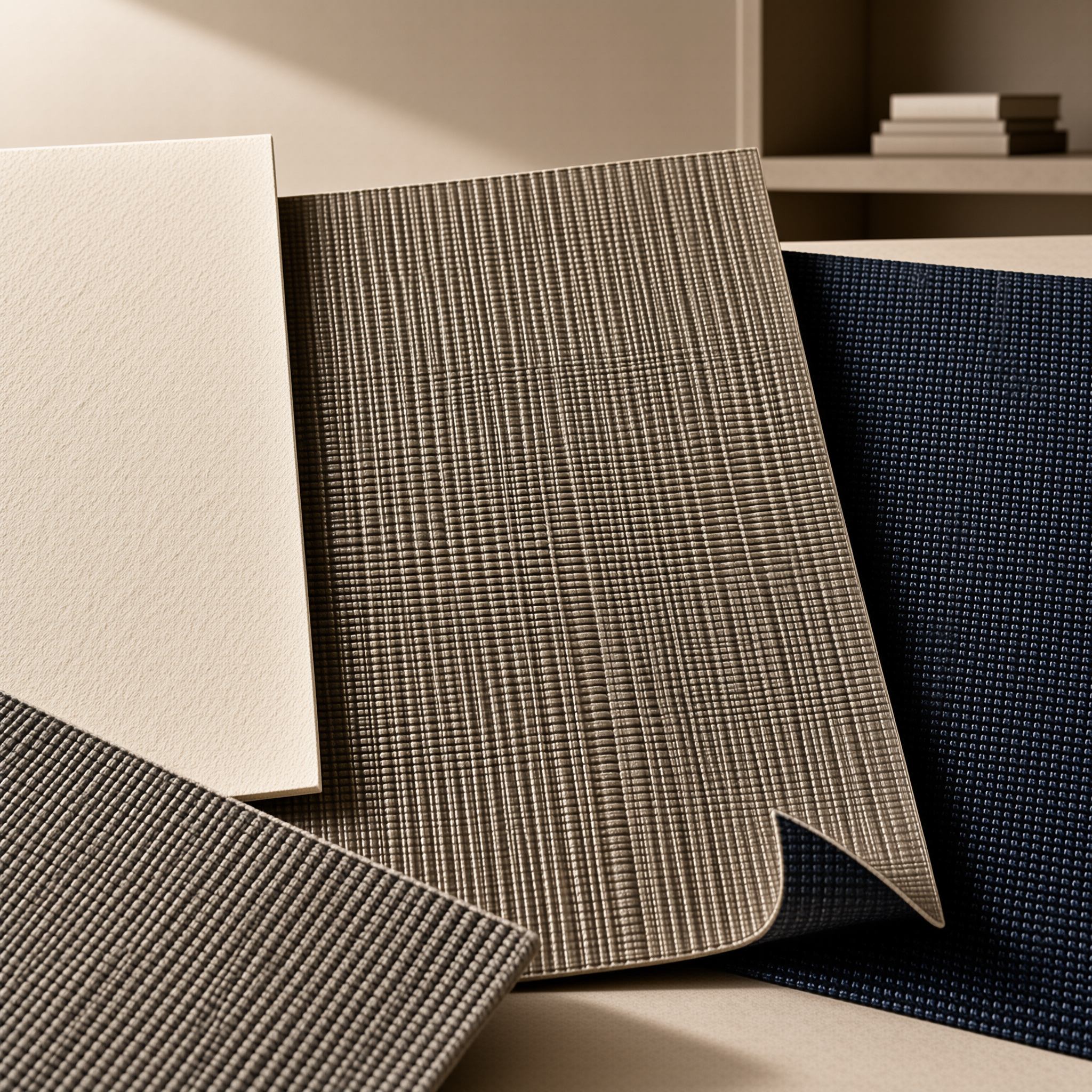
Custom Patterns and Brand Integration
Tight, high-contrast motifs expose every millimeter of registration error at a seam. Larger, lower-contrast repeats hide joint drift and reduce the number of panels that need alignment, which matters most in long corridor runs.
Repeating a brand mark is easy; repeating it at a scale that still reads at 4 m is not. Motifs below roughly 30 mm tend to dissolve into texture when viewed from standing distance, so scale testing belongs in the first sample round.
Color Matching and Repeat Sizing
Color matching is where custom digital wallcovering projects lose time. Screen colors, printed proofs and bulk production under different lighting will never match exactly, so the target is a signed-off physical proof, not a digital file.
Repeat size should be set against the real wall grid before artwork is finalized. A 600 mm repeat on a 900 mm panel creates an obvious cut, while the same motif at 450 mm aligns with the panel and the ceiling line.
Sampling and Production Lead Time
Sampling, not printing, is the schedule risk. Across more than 40 custom hotel wallpaper projects at VELORA5, our sampling stage typically runs 2–4 iterations before artwork, color profile and substrate are confirmed for bulk production (n=40+ projects, sampling log review, 2026).
Each round consumes review time from the designer, the brand team and the contractor. Sequencing those approvals against the FF&E handover date, rather than the order date, is what keeps a custom run on schedule.
Order the replacement stock with the first production run.
Matching Wallcovering to Each Hotel Zone: Lobby, Guest Room, Corridor, Restaurant
Hotel Lobby and Feature Walls
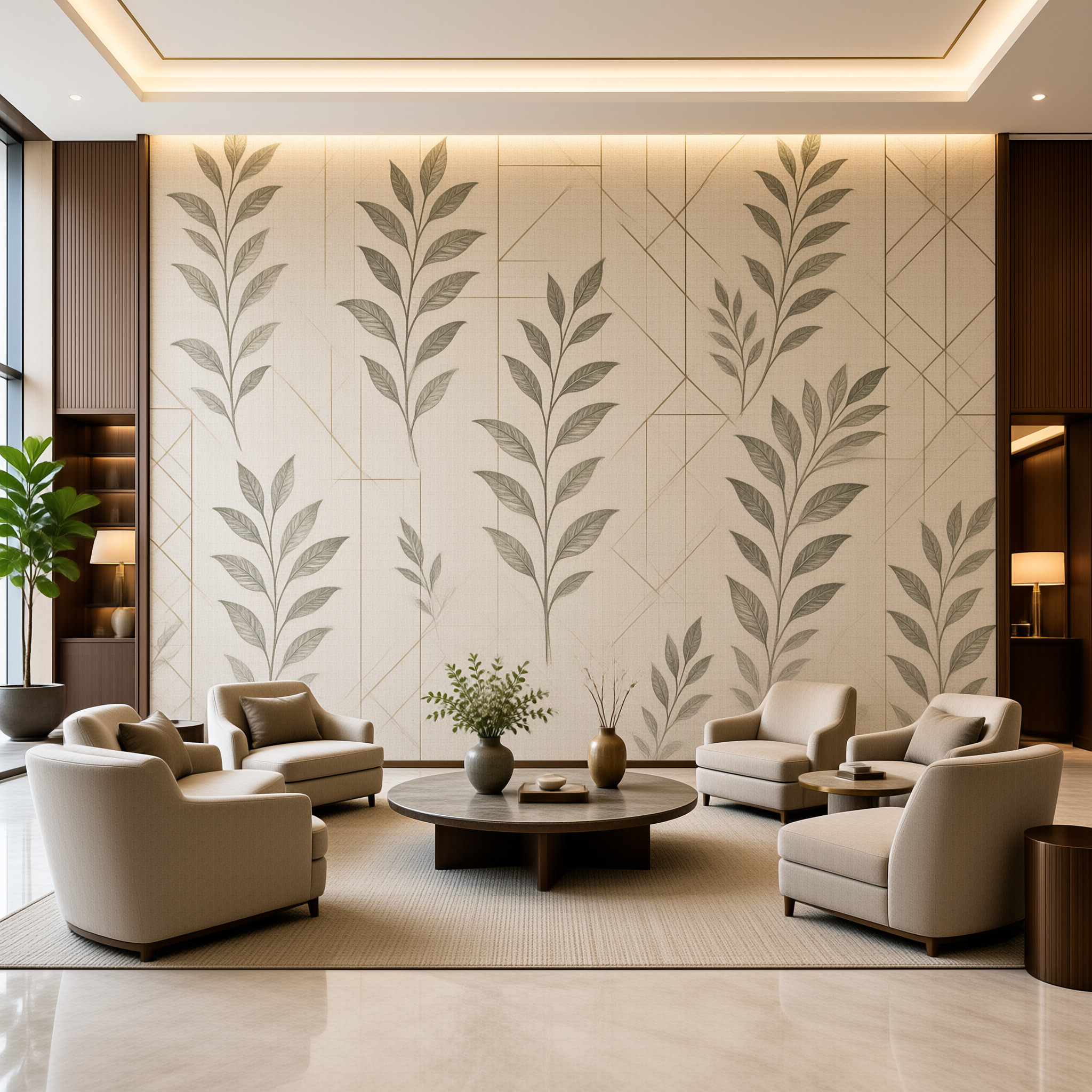
Lobbies carry the design load, not the abrasion load. A lobby wall is viewed up close and photographed often but touched rarely, so texture, depth and repeat scale matter more than scrub resistance.
Coordinating the wall with lighting and millwork matters more than the substrate alone. A textile-backed face that reads warm under a chandelier can flatten to grey under 3000K downlights at 2 m.
Guest Rooms and Headboard Walls
Guest rooms reward strip-and-replace speed. Non-woven and lightweight vinyl bases strip in wider sheets with less substrate repair, which shortens turnaround in a rolling refurbishment.
Headboard walls take hand and luggage contact, so a wipeable face is the safer default even when the design calls for a softer hospitality wallcovering.
Corridors and High-Traffic Zones
Corridors favor cleanability and joint integrity over texture, which is why contract-grade commercial wallpaper dominates corridor schedules. Long runs mean more seams, and seams are where most failures begin.
Wider rolls cut seam count directly. Moving from a 53 cm roll to a 137 cm roll removes roughly 60% of vertical seams on the same wall length, which also reduces installation labor.
Restaurants, Bars and Back-of-House
Food and beverage zones combine grease, splash and chair contact. Commercial wallpaper in these areas should default to a scrubbable, non-porous face, with decorative treatments held above the chair-rail line.
In a 180-key boutique hotel project, we supplied custom digital wallcovering for the lobby feature wall and branded headboard walls, paired with contract-grade commercial wallpaper across corridors and guest rooms; keeping one supplier across zones held color and material consistency across roughly 2,400 square meters of wall surface (n=1 property, 180 keys, project delivery review).
Installation, Maintenance and Replacement Planning
Most wallcovering failures reported after handover trace to substrate preparation, adhesive choice or site conditions during install — not to the face material, whether it is stock vinyl or custom wallcovering.
Wallcovering bonds to the wall, not to the paint. Residual paste, glossy paint or dusty gypsum reduces bond strength at the interface, so the failure appears along the adhesive line rather than in the face. Humidity above roughly 65% during curing slows adhesive set and leaves the panel vulnerable at the edges.
In post-installation reviews across 24 projects, seam lifting and edge curl accounted for the majority of first-year defect reports, and nearly all appeared where the wall had not been primed with a wallcovering-specific sealer (n=24 properties, internal observation, 2026).
Daily: dust with a soft brush or vacuum; avoid abrasive pads.
Weekly: wipe high-contact zones at handle and chair-rail height.
Quarterly: inspect seams around door surrounds and corners.
Refit: retain one unopened roll per dye lot for panel replacement.
Common Mistakes B2B Buyers Make When Sourcing Hotel Wallcovering
The most common sourcing error is ordering to the design quantity rather than the replacement quantity. Buyers compute yardage from wall area and skip the stock set aside for later panel replacement.
Dye lots cannot be reliably re-matched months later, so replacement stock has to come from the same production run as the original. Once that window closes, one damaged panel in a corridor forces a partial re-wall or a visible mismatch — a cost that scales with corridor length, not with the size of the damage.
A second frequent error is treating sampling as a formality. In custom work, 2–4 sampling rounds are normal, and projects that budget zero weeks for them usually absorb the delay later at a higher cost. Wallpaper for hotel interiors should be specified with the replacement allowance, sampling window and install sequence in the same document.
No replacement stock reserved from the original dye lot.
Sampling budgeted at zero weeks in the construction program.
Material approved from a screen instead of a physical sample under site lighting.
MOQ split across two suppliers, breaking color and material consistency.
Install scheduled before the substrate is primed and fully dry.
FAQ: Commercial Wallcovering for Hotels
- What is the most durable wallcovering material for hotel guest rooms?
- Type II contract-grade vinyl is the most durable and cleanable choice for guest rooms; non-woven sits close behind and is far faster to strip and replace during refurbishment.
- What is the difference between commercial and residential wallcovering?
- Contract-grade wallcovering is built for repeated cleaning, wider roll widths and consistent batch color across large project orders, while residential wallcovering prioritizes pattern choice and cost.
- How long does wallcovering last in a hotel?
- Plan on 5–7 years in corridors and 7–10 years in guest rooms under routine housekeeping; replacement is usually triggered by localized damage rather than full-wall wear.
- Can wallcovering be customized with a hotel's brand pattern?
- Yes. Custom digital wallcovering is printed from supplied artwork, with repeat, color profile and substrate confirmed through physical sampling before bulk production.
- What is the typical MOQ for custom commercial wallcovering?
- Custom digital runs are usually quoted by total yardage rather than by roll, so MOQ depends on the pattern repeat and substrate. Larger runs lower the per-square-meter setup cost.
- Are samples available before bulk production?
- Yes. Physical samples in the specified substrate are standard practice, and most projects confirm artwork, color and material across two to four sampling rounds.
A physical sample in the specified substrate, viewed under site lighting, is the only reliable way to approve a hotel wall finish.
The most reliable next step is to hold a physical sample in the exact substrate you plan to specify and view it under the lighting the finished wall will actually sit in, before the construction program locks. For project-specific specifications, VELORA5 prepares commercial wallcovering samples — custom sizes, colors, patterns and substrates — and a project quotation against your room count, corridor yardage and replacement stock.