Specify beach-inspired wallpaper for hotels and coastal homes: coastal motifs, ocean palettes, mural measurement, material checks and custom sampling.
Beach-inspired wallpaper brings coastal landscapes into an interior through ocean horizons, shoreline aerials, tropical foliage and abstract water patterns. Designers specify it as a single feature wall, a corridor run or a full-room wrap. The design decisions come first: motif, palette, scale and viewing distance, well before substrate and installation.
Coastal briefs usually go wrong when the theme is settled first and practical questions arrive late.
In most projects a better order is: define the wall and the viewing distance, shortlist two or three motif families, choose a palette that suits the light, then confirm the material route against the supplier's product data.
Key Takeaways
Motif family, palette and scale are design decisions; moisture tolerance and durability are documented product questions.
Long uninterrupted walls suit panorama murals, while fragmented walls suit repeats and quieter graphics.
Desaturated coastal palettes hold up better across refurbishment cycles than saturated tropical schemes.
Custom murals need a wall survey, physical sample approval and labelled panels before production starts.
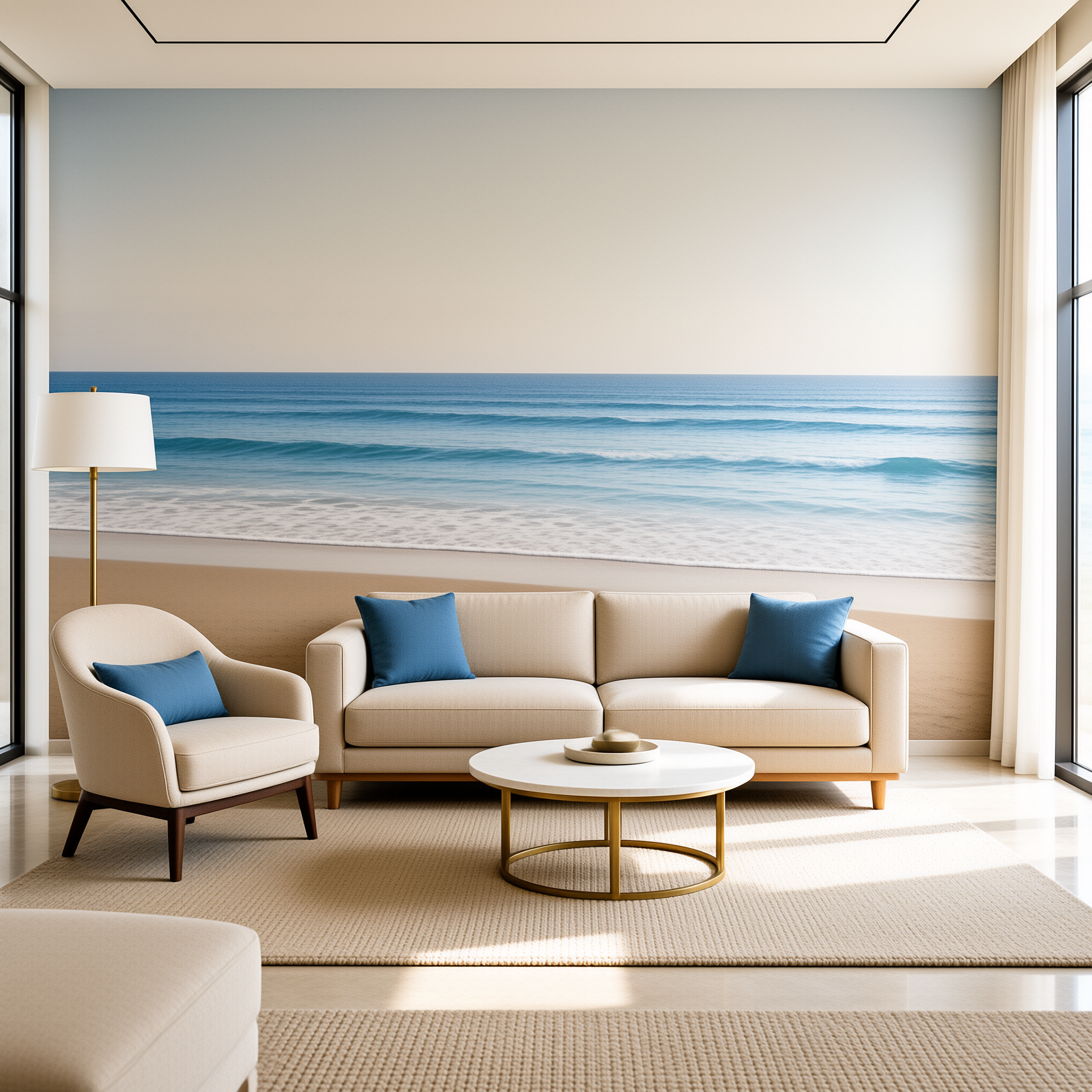
What Is Beach-Inspired Wallpaper?
Beach-inspired wallpaper covers wallcoverings whose motif is drawn from the coast: ocean horizons, shorelines seen from above, sand formations, tropical foliage and water movement. It arrives on site in one of two formats, a repeating pattern in rolls or a mural printed to a measured wall. That format choice affects waste, alignment risk and installation time more than the motif does. The VELORA Products catalogue lists both repeating patterns and made-to-measure mural formats.
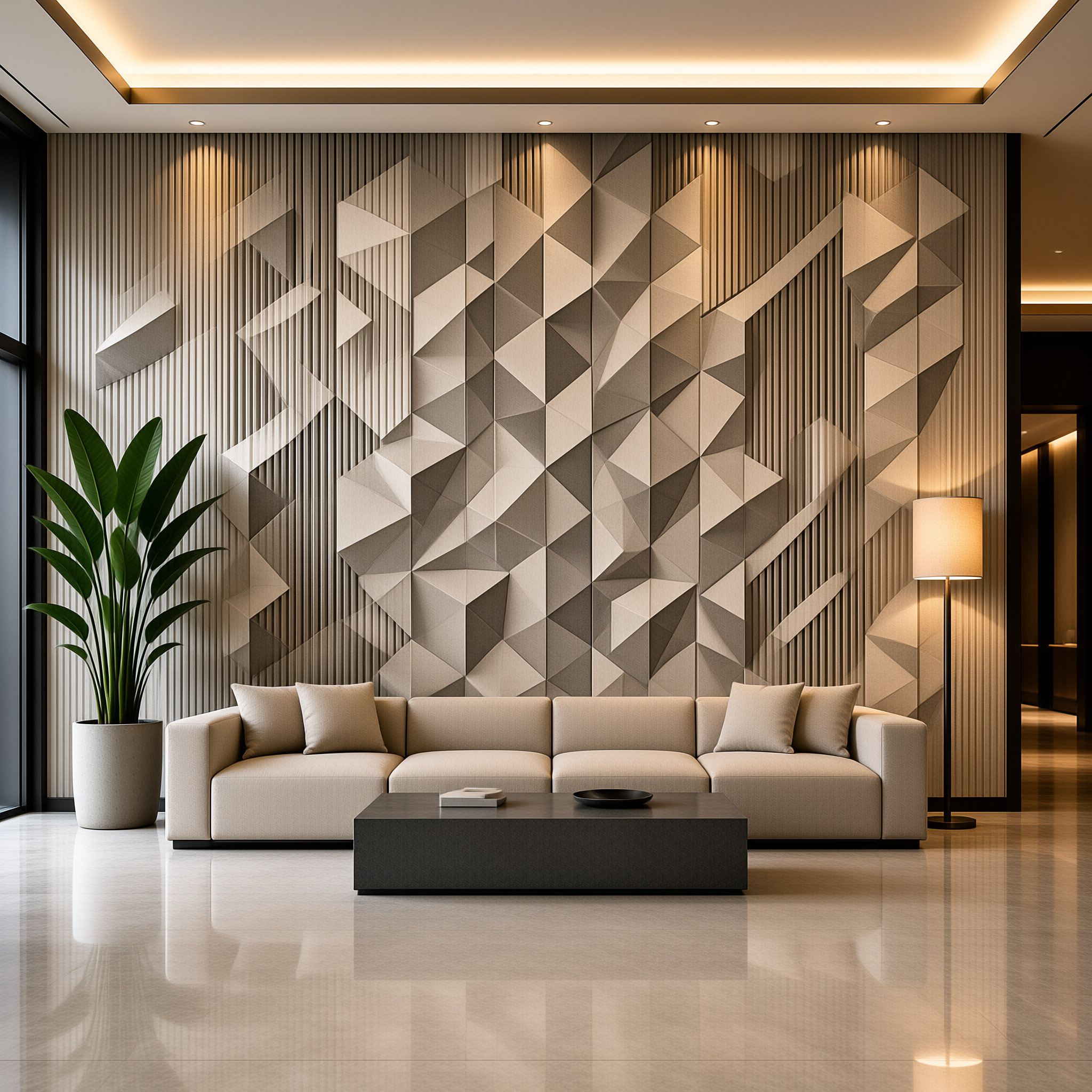
The range runs from literal to abstract. A full-height ocean wall mural sits at one end, a tonal watercolour wash or a fine line-drawn coastal botanical at the other. Buyers comparing both ends often find the quieter graphics easier to coordinate with stone, timber and existing artwork.
Placement style matters as much as imagery. One feature wall is the low-risk default, while a coordinated scheme across a suite, corridor or lobby needs a motif family defined up front. VELORA's design collections group repeating patterns and panoramic formats so both routes can be judged side by side.
One distinction matters from the start. Ocean imagery is a visual theme. Water resistance, cleanability and durability come from the substrate, finish and installation conditions, so a mural of waves tells you nothing about how a wall will behave in a humid corridor.
Coastal imagery is a visual theme, not a performance grade: a beach scene printed on a standard substrate still behaves like a standard substrate.
Popular Coastal Wallpaper Patterns and Design Themes
Most projects need two or three motif directions, not ten. Shortlist against the architecture first: wall length, openings, ceiling height and the distance from which the design will normally be seen. Then compare graphics that fit those constraints.
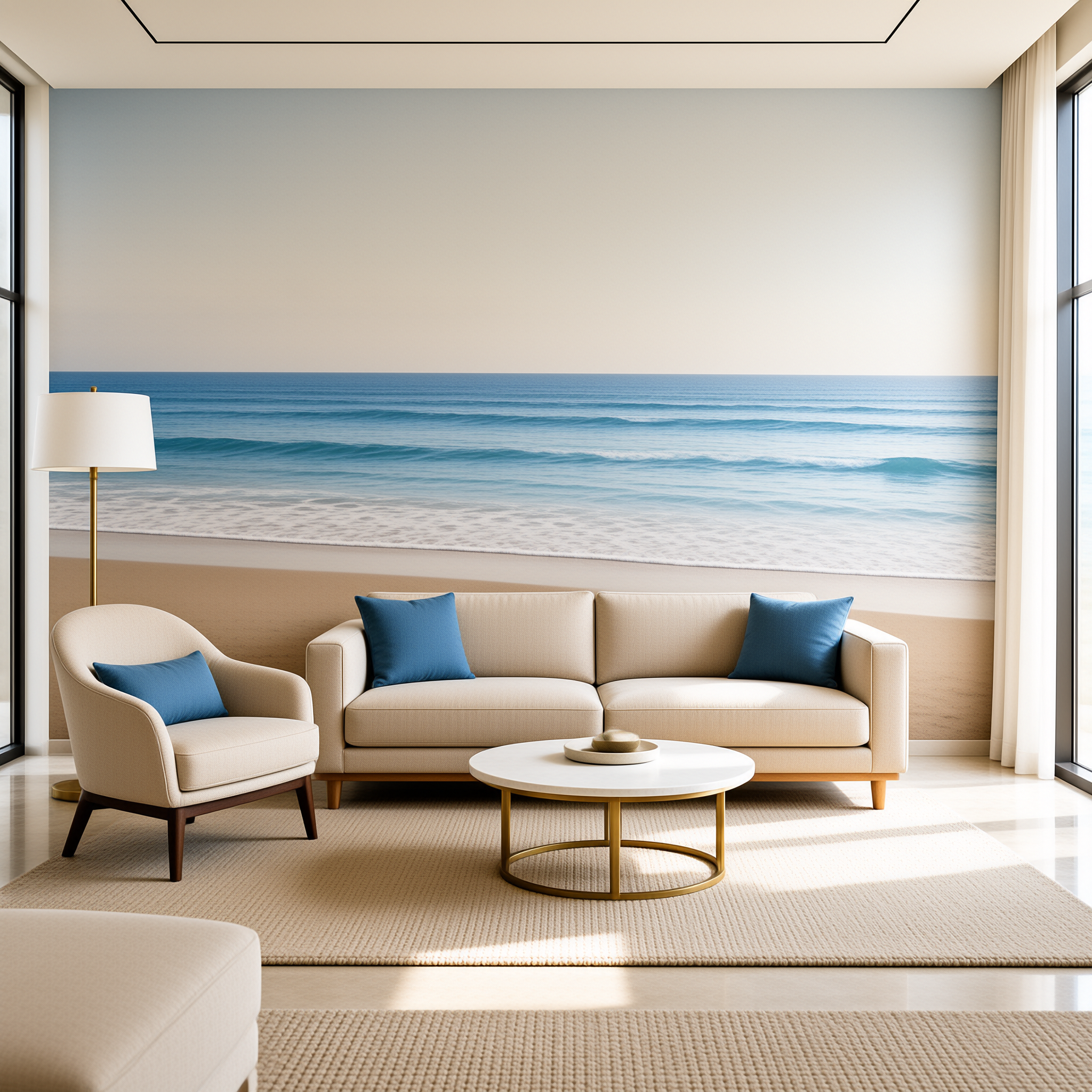
Ocean horizon and panorama motifs are strongest on long, uninterrupted walls, typically behind reception or a bedhead. They are weakest where doors, windows and risers break the wall, because the horizon line has to survive every interruption. Confirm where that line sits relative to eye level before approving artwork. Aerial shoreline, sandbar and tidal patterns, by contrast, read as subtle graphics at distance and stay calm up close. They suit long corridor runs and pre-function areas where guests pass rather than stop, but fine detail can turn to visual noise when viewed from far away, so ask for a rendering at the real viewing distance.
Tropical foliage and coastal botanical illustrations add warmth against hard finishes. Silhouette versions read bolder and hold up in high-energy spaces, while illustrated etchings read quieter and suit bedrooms. Both work well beside rattan, pale timber and woven textiles.
Abstract wave, ripple and watercolour-wash graphics are the most flexible option. They work in mixed-use spaces, tolerate imperfect wall geometry better than a horizon line, and coordinate with artwork elsewhere in the scheme.
Scale is the most frequent surprise. A repeat that reads quietly on a sample can dominate a four-metre wall, so request a scale reference or a render in context before sign-off.
| Motif direction | Reads best at | Typical placement | Watch out for |
|---|---|---|---|
| Ocean horizon / panorama | Long views beyond 3 m | Lobby back wall, headboard wall | Horizon breaks at openings and corners |
| Aerial shoreline / tidal pattern | Medium to long views | Corridors, spa, pre-function areas | Fine detail becomes noise at distance |
| Tropical foliage / botanical | Close to medium views | F&B, beach club, bedrooms | Bold silhouettes overwhelm small rooms |
| Abstract wave / watercolour wash | Any distance | Mixed-use, full-room wraps | Low contrast exposes wall flatness |
Color Palettes Inspired by Beaches and Oceans
Palette decides atmosphere before motif does. Deep navy and ocean blue compress a room and push it toward evening formality, while pale sky blue and misted tones open a space up. The same horizon mural can read formal or breezy depending on where it sits on that range.
Seafoam, aqua and muted teal add coastal reference without the saturated novelty look. They sit comfortably next to natural stone, pale timber and brushed metal, which is why they recur in spa and arrival areas. Sand, beige, ivory and warm off-white do the grounding work. On a large mural these neutrals decide whether the scheme reads airy or heavy, and they set how much blue the room can carry.
Saturation is also a lifecycle question. Desaturated palettes usually age better across refurbishment cycles, while saturated tropical palettes need stronger lighting balance and more deliberate adjacent finishes. Interior reference platforms such as Houzz help when testing a palette against real furniture and finishes.
Daylight is the final check. Glass-heavy coastal lobbies shift perceived colour through the day, and glare can flatten pale tones. Review strike-offs in the actual space, or under lighting that matches it, before approving.
| Palette family | Atmosphere created | Suits |
|---|---|---|
| Deep navy and ocean blue | Compressed, formal, evening | Snug bars, formal dining, club lounges |
| Pale sky blue and misted tones | Open, airy, quiet | Glass-heavy lobbies, compact guest rooms |
| Seafoam, aqua, muted teal | Fresh coastal reference | Spa, arrival areas, wellness |
| Sand, beige, ivory | Grounded and calm | Large murals, layered neutral schemes |
| Saturated tropical | High energy, warm | Beach clubs, seasonal outlets |
Beach Wallpaper Ideas for Hotels and Resort Interiors
In arrival and lobby areas, a full-height ocean or shoreline mural behind reception gives the property a signature backdrop.
Keep neighbouring walls quieter so the mural keeps its impact, and check that the horizon lands correctly against desk height and guest eye level.
Guest rooms reward a focus on the headboard wall, the highest-value placement in most schemes. Full-room wraps suit compact rooms where one motif can unify the space, though they demand careful alignment around built-in joinery and wardrobes. Confirm durability and cleanability from product data; the motif alone proves nothing.
F&B outlets, beach clubs and bars tolerate higher visual energy, and tropical foliage or abstract wave graphics suit warm, low lighting. Spa, wellness and circulation areas work better with soft tonal water and sand motifs that support wayfinding without competing with signage.
Multi-property consistency is a design system question rather than a wallpaper choice. Define the motif family and palette once, then vary scale or artwork per property. The brand reads consistently without repeating the same wall in every building.
Specification then moves to substrate class and site conditions. Our commercial wallcovering for hotels guide covers those technical decisions, including the durability questions that sit outside the design brief.
Coastal Wall Murals for Luxury Residential Spaces
Double-height living spaces and stairwells are the best candidates for a continuous panorama. They also carry the most risk, because artwork finalised before a wall survey often needs re-cutting. Measure the wall first, then design to the measured elevation.
Bedrooms and dressing areas usually want softer tonal or botanical motifs. Dramatic horizons are better reserved for living and entertaining zones that are used in daylight and in company.
Framing changes how resolved a mural looks. Murals read better when bounded by panelling, shadow gaps or millwork than when they stop at an arbitrary point on a flat wall. Architecture libraries such as ArchDaily are useful for seeing how completed interiors handle those junctions.
Coordinate with finishes already specified. Pull two or three colours from adjacent stone, timber and metal into the mural palette rather than introducing new ones, and check how sheen behaves under direct sun in rooms with large glazing.
Choosing Materials and Patterns for Coastal Interior Projects
Run the selection sequence in order: zone and traffic first, then substrate, then pattern format, then artwork. Reversing it is how projects end up with a strong design on a wallcovering that cannot meet the cleaning or durability requirement.
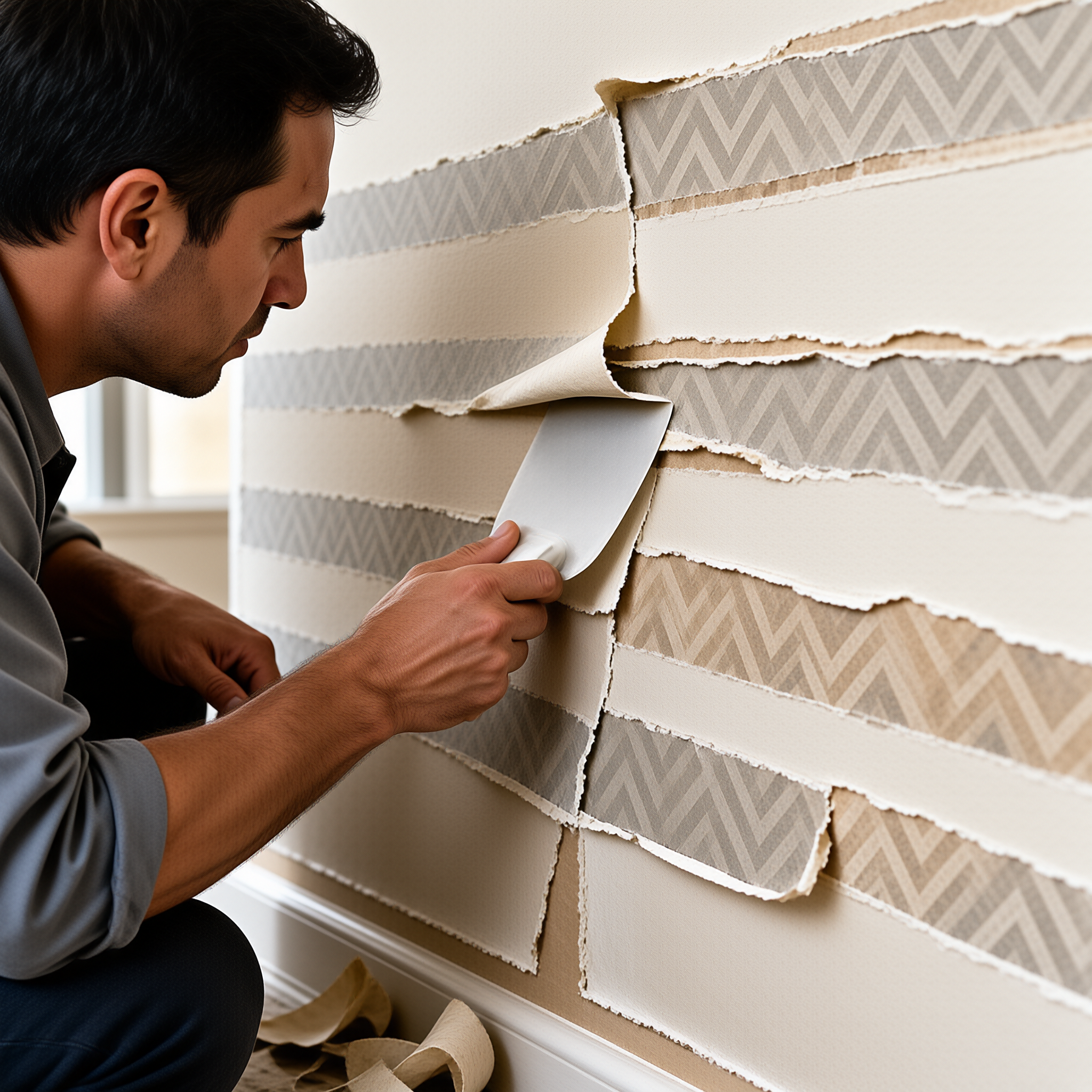
Suitability must be confirmed from the supplier's product data and the installation conditions on site. A coastal motif does not make a wallcovering waterproof, moisture-tolerant or suitable for wet areas. Buyers often ask for beach wallpaper when they mean a specific performance class, so separate those two questions early. Wall condition drives the outcome. Surface preparation and substrate flatness affect adhesion and also how a large-scale mural reads, because ripples and patches show through low-contrast graphics.
Commercial and residential expectations differ in durability, cleanability and replacement cycles. Confirm which class the project needs before comparing prices, since a cheaper roll that fails in year two is not a saving. Our premium commercial wallcovering range is the starting point for higher-traffic zones.
Pattern repeat versus full mural changes waste, alignment risk and installation time. Decide it early, because it determines how artwork is produced and how panels are numbered for the installer.
How Do You Measure a Wall Before Ordering a Coastal Mural?
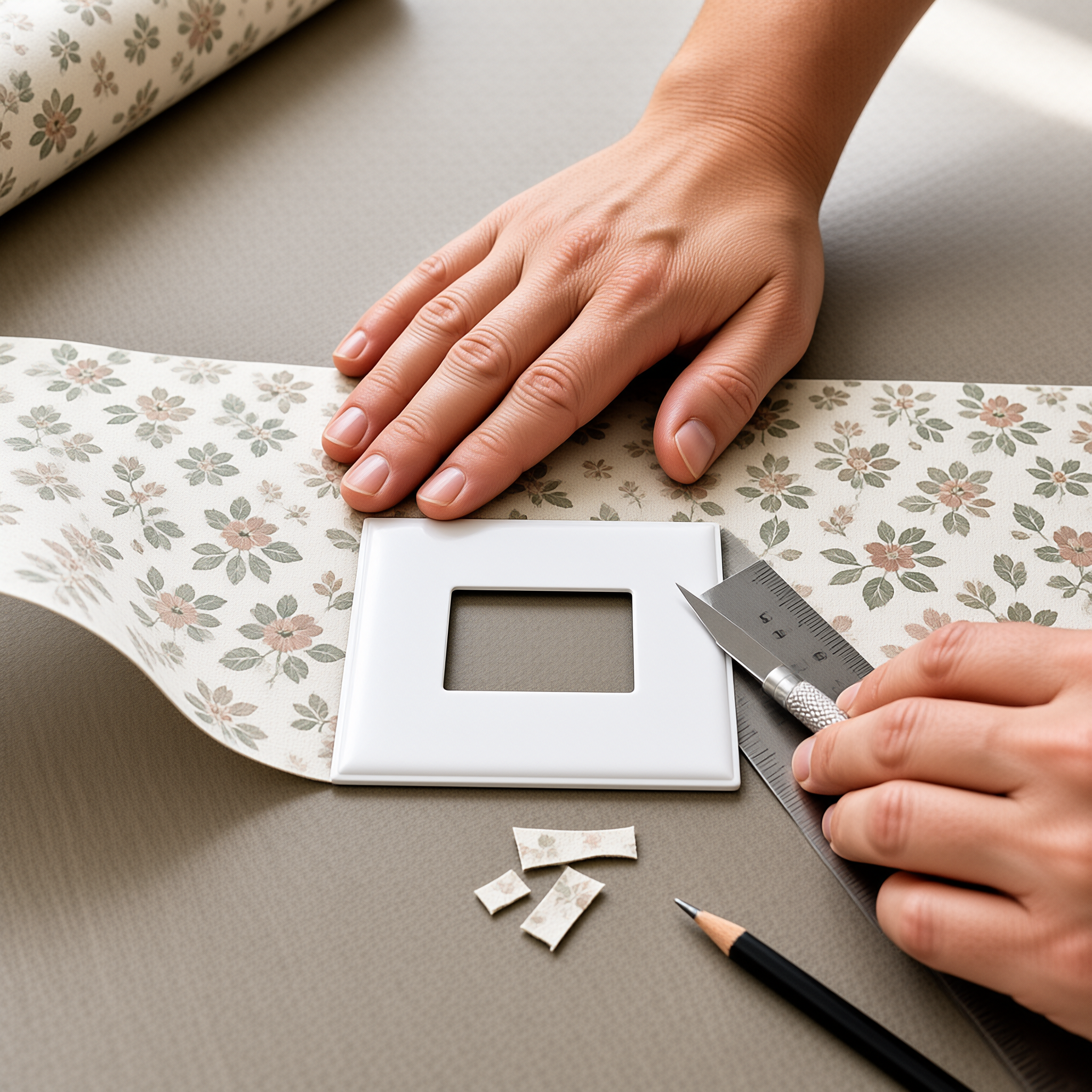
Measure the finished wall face and issue an elevation, not a floor plan or a scaled drawing. The factory needs overall width and height, panel count, and the alignment points where the design must line up with key features such as a reception desk or a bed centre. Record every obstruction: sockets, switches, radiators, joinery returns and any wall that is out of square. Corners and returns are where panorama murals most often go wrong, because the design has to continue across a change of plane without an obvious break.
Add trim allowances for skirting, cornice and ceiling shadow gaps, and note ceiling height at both ends of the run. A 20 mm difference across six metres is normal in older buildings and has to be absorbed somewhere in the artwork.
A laser measure plus photographs is usually enough for a first quote. Production needs a measured elevation with panel divisions marked and numbered to match the delivered panels.
Custom Beach-Inspired Wallpaper for Hospitality Projects
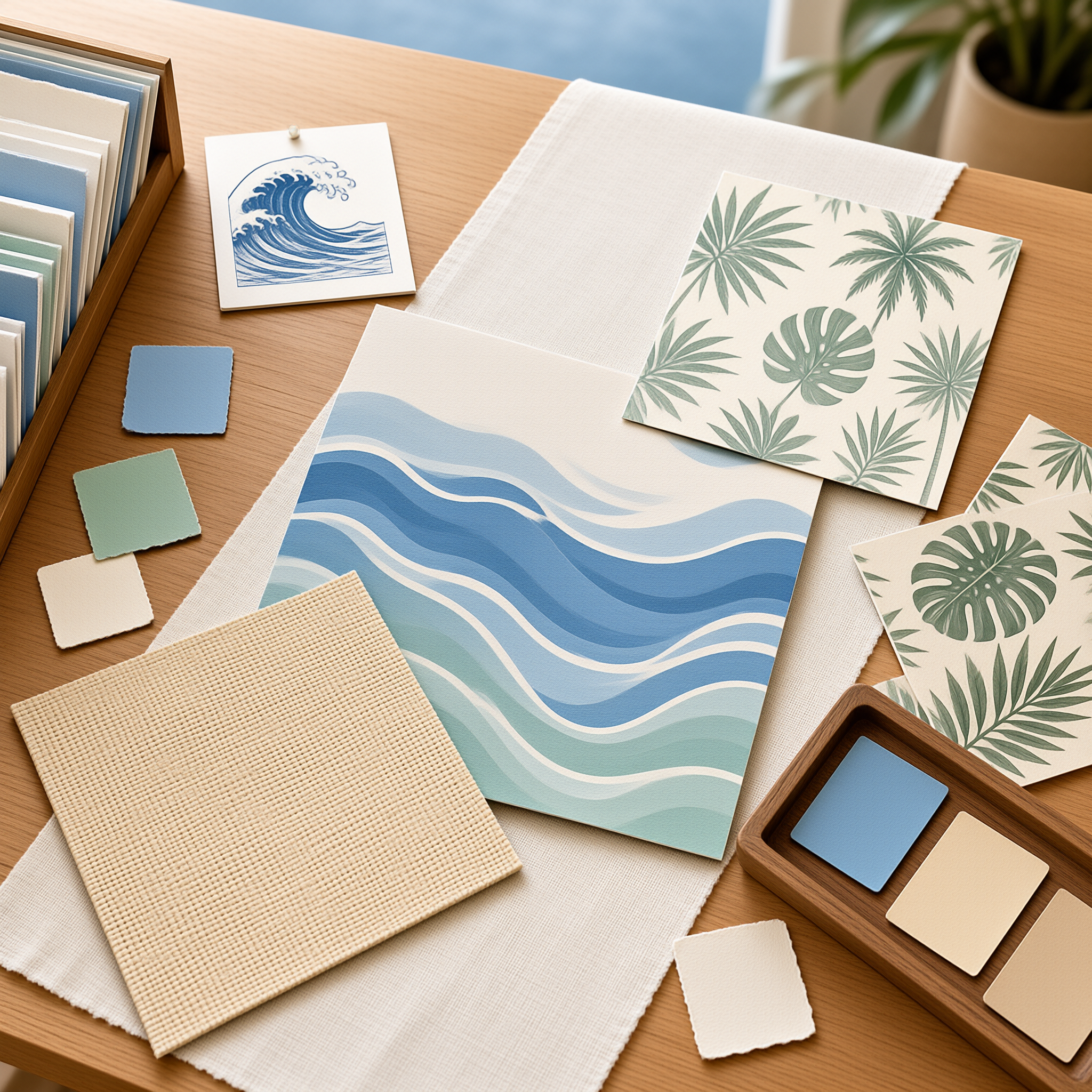
Custom work starts from a brief or moodboard: motif references, palette direction, architectural constraints and the brand position of the property. A clear brief reduces artwork rounds and keeps sampling costs down.
Artwork development follows, then a strike-off sample.
Approve colour and scale on a physical sample rather than on screen, and treat the signed sample as the production reference for the rest of the order.
Production preparation covers file setup, repeat or panel build, and panel labelling that matches the installation drawing. This is where custom beach wall murals for hospitality projects either arrive in a clean sequence or arrive as a site puzzle.
VELORA works as a custom wallpaper manufacturer on exactly this route, supporting decorative artwork development, customized mural dimensions, material selection and sampling before project-based production. Panels are numbered and sequenced to the installation programme rather than to a generic order. The custom wallcovering OEM and ODM service page shows how brief, sampling and production stages connect.
Frequently Asked Questions
- What colors are suitable for coastal wallpaper?
- Ocean blues, seafoam greens, aqua, sand, beige, ivory and muted naturals are the core coastal range. Deep blues read formal and pale tones open a space up. Test any palette in the actual lighting before sign-off.
- Is beach wallpaper suitable for hotel guest rooms?
- Yes, particularly on headboard walls where a single motif carries the room. Suitability depends on the substrate, finish and cleanability of the specified product, so confirm those from supplier data rather than from the artwork.
- What is the difference between coastal wallpaper and tropical wallpaper?
- Tropical wallpaper is foliage-led and warmer, built around palm, banana and fern motifs. Coastal wallpaper is broader and often water-led, covering horizons, shorelines and abstract wave graphics. The two overlap in resort schemes.
- Can beach landscape wallpaper be customized for large walls?
- Yes. Landscape murals are normally produced to measured wall dimensions, divided into numbered panels that align across the full run. Corners, returns and ceiling heights are built into the panel plan.
- What should buyers consider before ordering custom wall murals?
- A measured elevation, artwork files, physical sample approval, material class and the installation programme. Panel numbering and delivery sequence matter as much as the design itself.
- Does a coastal ocean mural resist moisture because of the subject?
- No. Imagery has no effect on performance. Moisture tolerance comes from the substrate, adhesive and site conditions, so specify the product for the zone rather than for the picture.
Beach-inspired wallpaper rewards projects where theme and technical route are decided together. Shortlist the motif against the architecture, choose a palette for the light, then let product data settle the substrate question. Done in that order, a coastal scheme reads calm on opening night and still holds up after the first refurbishment.