Decorate removable outlet and switch cover plates with matching wallpaper: pattern planning, adhesive control, safe trimming and reinstallation.
Wallpaper outlet covers are removable outlet or switch plates finished with a small piece of the same wall covering used behind them. The paper goes onto a detached plate at a workbench, never over a live opening. Pattern repeat matters more than speed here, because a mismatched plate draws the eye faster than a plain white one ever would.
Only the removable cover plate is decorated. No paper, adhesive, or trim should ever enter an outlet or switch opening.
Key Takeaways
Wallpaper outlet covers are decorative removable plates, not paper applied over live electrical openings.
Pattern repeat, pattern direction, and an oversize cut before trimming drive the final look.
Compatible adhesive applied sparingly, plus full drying, prevents bubbles, shrinkage, and edge lift.
Receptacles, switch mechanisms, and wiring must stay completely unobstructed.
Commercial projects need device compatibility, maintenance, and compliance checks before specifying.
What Wallpaper Outlet Covers Are, and What They Are Not
The phrase describes a finish detail on a removable plate. A small piece of matching wallcovering is bonded to the face of the plate, then the plate returns to the box.
The receptacle, the switch mechanism, and the wall opening stay bare. Anything that blocks them is a hazard, not a finish.
In most projects the detail earns its keep on feature walls, bold repeating prints, and custom murals. A plain white plate breaks the visual run of a pattern, and on a small wall that break is easy to spot. On quiet neutral walls the same detail usually disappears, so it adds labor for no visible gain. That trade-off is the first thing to judge before you cut anything.
The plate sits inside a strong repeating or large-scale motif.
The outlet or switch falls on a feature wall or a custom mural.
The plate is visually prominent, for example centered between windows.
A designer is specifying coordinated details across a whole room.
Tools, Materials, and Cover Plate Selection
Start with the plate itself. Choose a flat, smooth, undamaged plate in the correct configuration for the device. Decorative plates with deep grooves or raised borders fight the paper and rarely trim cleanly. If a plate is cracked, loose, or the wrong size for the box, replace it instead of decorating it.
Removable outlet or switch cover plate
Offcut of matching wallpaper, plus a scrap for testing
Wallpaper adhesive suited to the material
Ruler, pencil, and a cutting mat
Sharp craft knife or scissors
Soft cloth or smoothing tool
Clean, flat work surface
Thick and textured materials deserve a trial run. Paste a scrap onto the back of an old plate or a spare tile, let it dry, then trim it.
This tells you whether the adhesive bleeds through, whether the texture flattens, and whether the edges stay crisp. In practice, five minutes of testing saves a whole plate.
Pattern Planning and Measuring Before You Cut
Lay the plate over the wallpaper and choose the section you want to see on the finished face. Center a small floral motif. Align a geometric repeat with the wall's grid. Let a marble or stone design continue its movement. On a custom mural, protect the detail that makes the image readable.
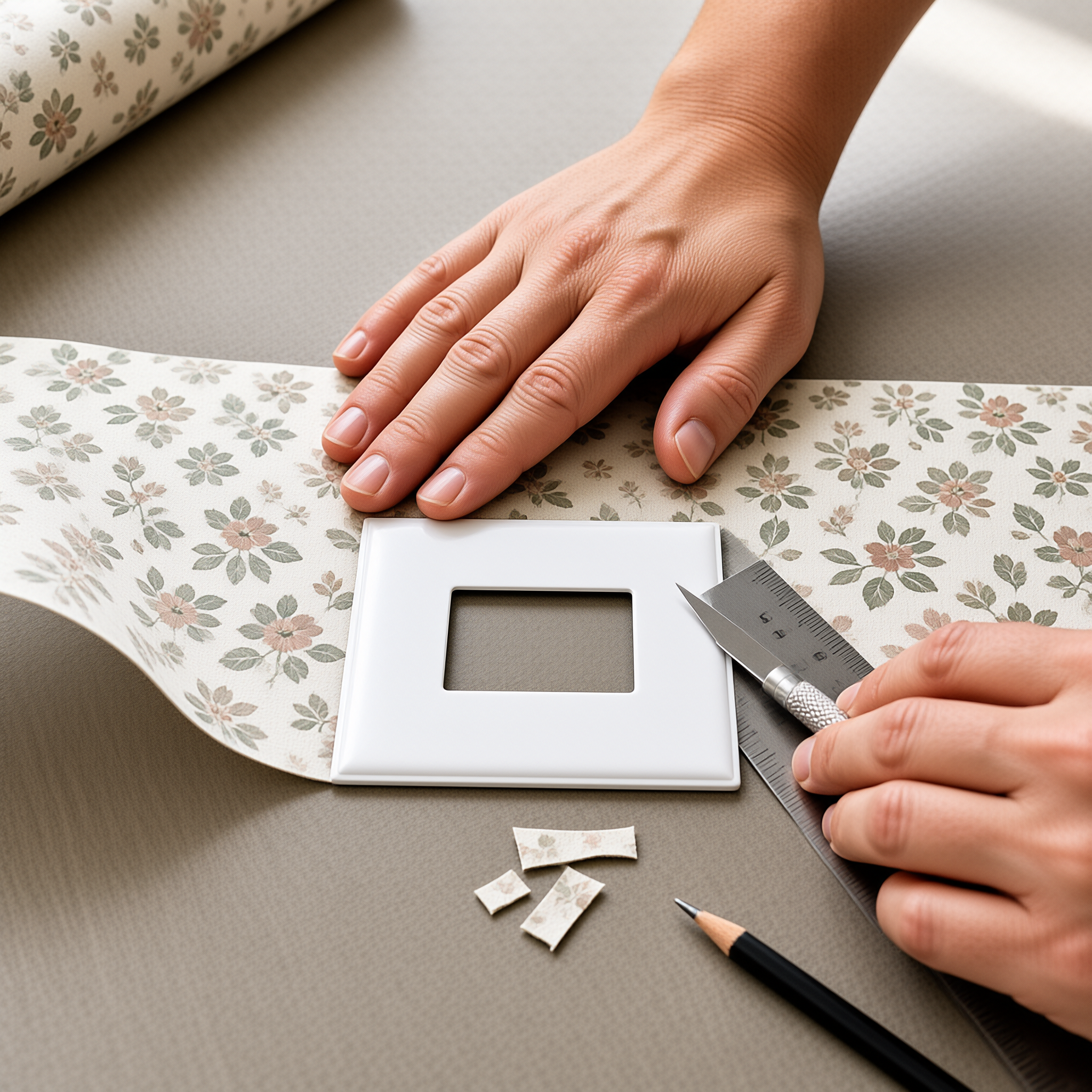
Then check the pattern repeat and the pattern direction. A plate cut from the wrong part of the repeat, or rotated ninety degrees, will read as an error from across the room. Mark the top edge lightly on the back of the paper so the orientation survives handling.
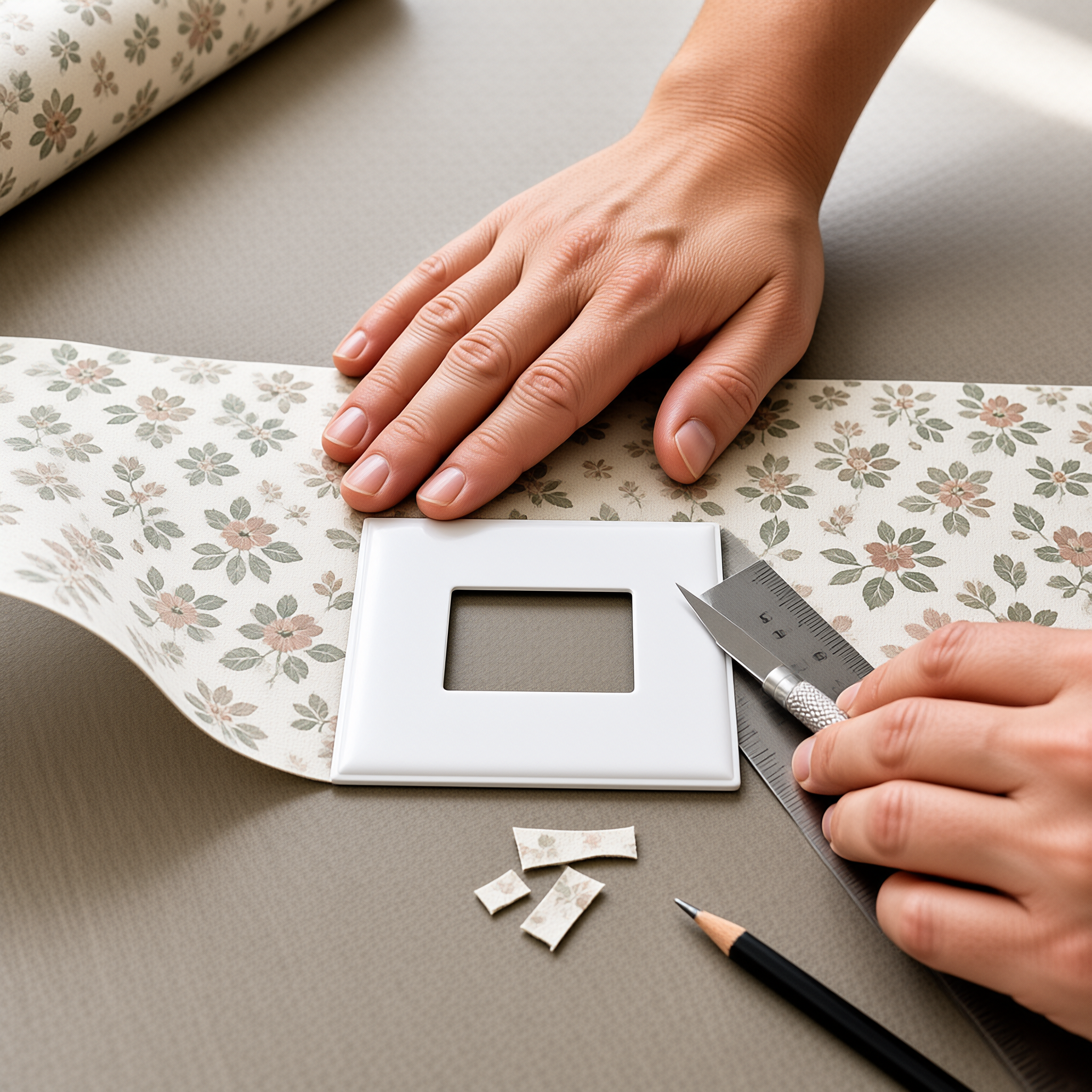
Measure the outside dimensions of the plate and cut oversize, leaving 10 to 15 mm of waste on every side. Extra material lets you reposition the motif and still trim a clean edge.
Cutting to exact size first is the single most common reason a plate ends up crooked.
Applying Wallpaper to the Cover Plate
Follow the adhesive maker's instructions on which surface gets the paste and how much. Spread an even, thin layer. Excess adhesive is the usual cause of bubbles, wrinkles, and residue that creeps around the edge and dries visible.
| Wall covering type | Adhesive approach | Main risk |
|---|---|---|
| Non-woven or paste-the-wall | Even paste on the plate face, paper applied dry | Creasing if the dry paper is pressed too hard |
| Vinyl or coated paper | Thin, even paste, face wiped immediately | Adhesive smear on the coated face |
| Textured or embossed | Test scrap first, light pressure only | Flattened texture and lifted edges |
| Thick mural or grasscloth | Adhesive type confirmed with the supplier | Bleed-through and bulky edges at the trim |
Place the paper, check the alignment against your chosen motif, then press. Smooth from the center outward to push trapped air to the edges. Do not stretch the material. Stretched paper distorts the pattern and pulls back as it dries, which opens gaps at the trim line.
Trimming, Drying, and Reinstalling the Plate
Trim the waste on a cutting mat with a fresh blade, turning the plate rather than angling the knife. Work slowly and let the knife follow the plate edge. For plates with openings, cut the paper back so every electrical opening stays fully clear. Nothing should sit under the plate face where the device meets the wall.
Dry the plate flat and face up, following the adhesive instructions. Then check the bond at the edges before it goes anywhere near the wall. Reinstall only when the paper is firmly attached.
Removal and reinstallation around electrical devices should be done with the circuit de-energized, or by a qualified electrician.
Matching Wallpaper Around Outlets and Switch Plates
Matching wallpaper around outlets is a compromise, and knowing that early keeps expectations realistic. A cover plate is a separate component sitting slightly off the wall plane, so it rarely lines up perfectly with the repeat behind it. Aim for a balanced visual relationship rather than a continuous flow across the plate edge.
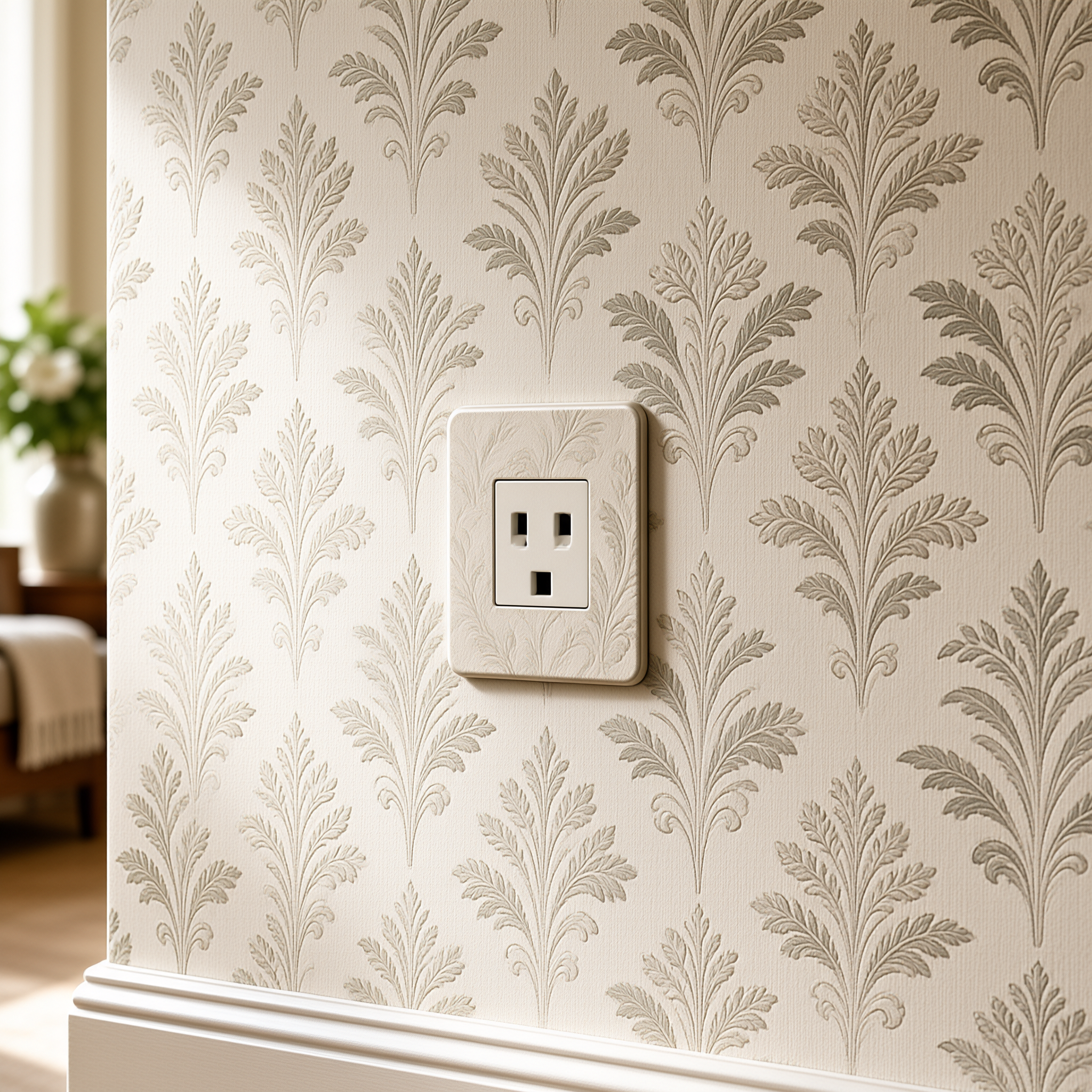
On large-scale repeats, exact alignment between plate and wall is usually not achievable, and trying to force it creates a worse result than a well-chosen balanced crop.
Check the repeat before cutting, not after gluing.
Keep pattern direction identical to the surrounding wall.
Avoid landing a prominent motif on an awkward edge.
Compare plate and wall from normal viewing distance, not from 20 cm.
Treat switch plates the same way, with the switch opening and mechanism fully clear.
Electrical Safety Rules and Common Mistakes
Electrical safety outranks appearance in every case. Never paper over an outlet or switch opening, never cover contacts or mechanisms, and never let adhesive run into a box. Do not use paper to hide a damaged device, and do not fit a plate that is cracked or incompatible.
General household guidance on keeping outlets protected and clear, such as CPSC childproofing guidance, is a useful reminder of why openings stay unobstructed.
Turn off the relevant circuit before any permitted plate work, and confirm it is dead rather than assuming. If you cannot confirm that, stop and call an electrician. Buyers often misunderstand this step as optional on a low-voltage detail, but the plate sits directly over live conductors.
The rest of the failures are cosmetic and predictable. Too much adhesive. Paper cut too small. Pattern direction ignored. Plate reinstalled while still wet. Each one is cheap to prevent at the bench and expensive to fix on the wall.
Are Wallpaper Outlet Covers Suitable for Commercial Interiors?
Sometimes, and selectively. Decorative plates suit residential feature walls, boutique interiors, and hospitality spaces where coordinated detail is part of the design story. They suit poorly in corridors and high-turnover hotel rooms, where cleaning cycles and abrasion punish delicate paper edges.
For any commercial specification, verify four things: that the device and plate remain compatible, that the project's building requirements are met, that the material suits the cleaning regime, and that accessibility and maintenance are unaffected. The decorative treatment must not change the plate's fit or function.
Where paper cannot meet those tests, a powder-coated or metal plate in a matched color is the practical substitute.
Plan the detail alongside the rest of the wallcovering package rather than after it. Color, texture, and repeat all need to agree, and that is easier when one supplier coordinates the run. VELORA's custom wallcovering OEM/ODM service supports project-based development, and the range of decorative wallcoverings covers both residential and contract work. For hotel-specific material and maintenance questions, the commercial wallcovering guide for hotels covers durability and specification in more depth.
Planning Wallpaper Outlet Covers Into the Design
Wallpaper outlet covers work best as a planned detail, not a last-minute fix. Order a little extra paper for plates and switch plates at the same time as the wall, because a matching offcut later is rarely possible. Note the repeat and direction so the installer cuts from the right area of the roll.
The method itself is simple: select a sound plate, plan the motif, cut oversize, paste sparingly, trim clean, dry fully, reinstall dead.
Keep the electrical openings clear at every stage, and the detail stays decorative. Skip that discipline and it becomes a safety problem with a nice pattern on top.
Frequently Asked Questions
- Can you put wallpaper on outlet covers?
- Yes, on a suitable removable cover plate. The paper must not obstruct electrical openings or interfere with how the plate seats against the wall.
- Can you wallpaper over an electrical outlet?
- No. Wallpaper must never cover an outlet opening, receptacle, switch mechanism, or any live electrical component. CPSC childproofing guidance explains why openings should stay clear.
- How do you match wallpaper around outlet covers?
- Identify the repeat, lay the plate over the paper, and choose the section that reads best against the wall. Keep pattern direction consistent, and judge the result from normal viewing distance.
- Can you use any wallpaper on outlet cover plates?
- Not every paper and adhesive pair suits every plate. Test on a scrap first, and confirm the finished plate still fits and functions correctly.
- Do wallpaper outlet covers affect electrical safety or code compliance?
- A correctly finished plate should not. Any treatment that blocks an opening, covers a mechanism, or stops the plate seating properly does, and that is a compliance issue rather than a cosmetic one.
- How do you stop wallpaper edges from lifting on a cover plate?
- Use less adhesive, trim on a fresh blade, and press the edges down before drying. Full drying flat, face up, prevents the shrinkage that pulls edges away.
- Can you wallpaper a cover plate with thick or textured wallpaper?
- Often yes, but test first. Thick papers bulk up at the trim and can flatten under pressure, so a sample run shows whether the edge will stay crisp.
- How should you clean a wallpaper-covered outlet plate?
- Dust with a dry or barely damp cloth and avoid soaking the paper or the plate edge. Vinyl and coated surfaces tolerate a light wipe better than uncoated paper.