How printed 3D effect wallpaper creates visual depth, how to scale patterns for feature walls, and how buyers should specify print versus emboss.
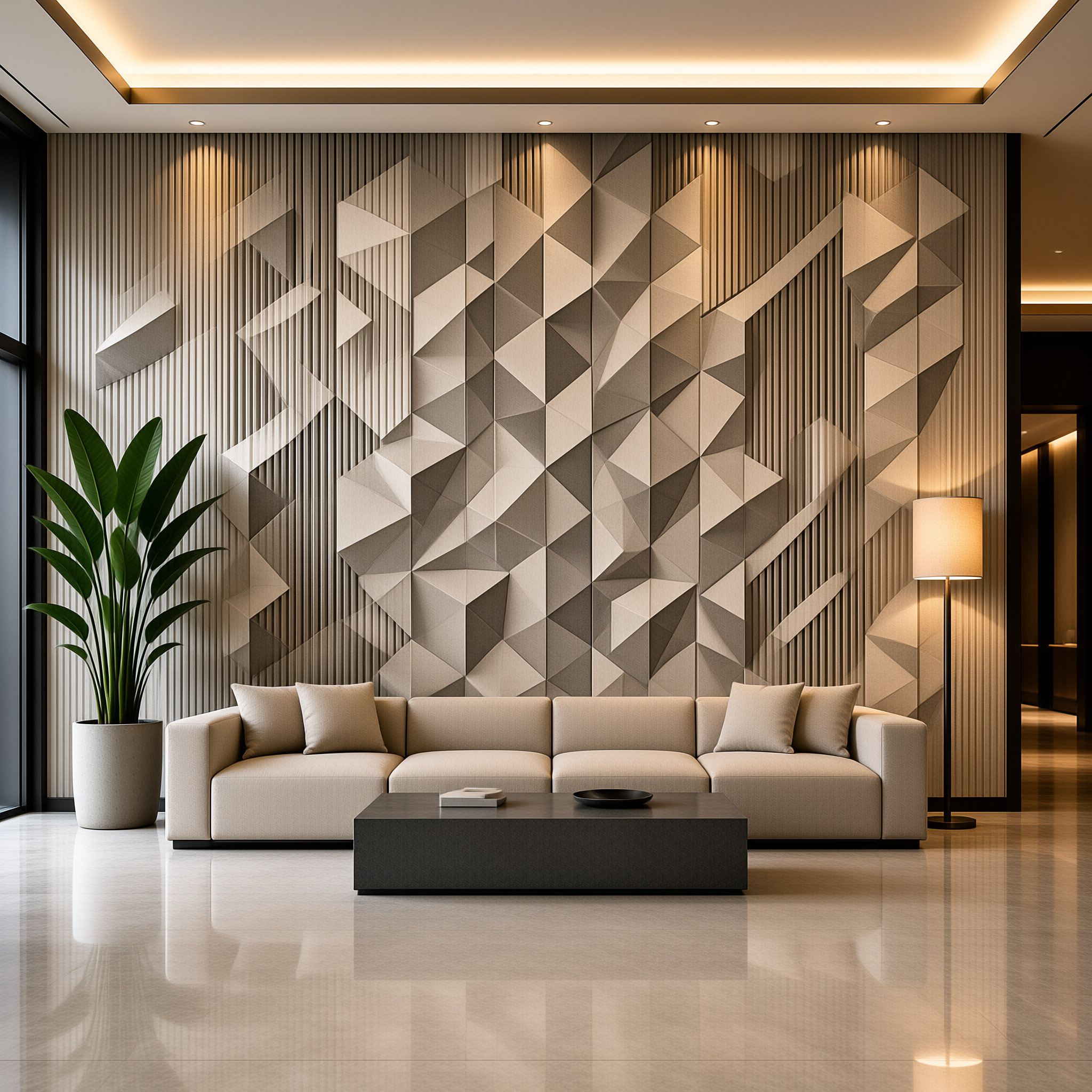
3D effect wallpaper is a flat wallcovering whose printed artwork is drawn to look deep. Perspective lines, gradient shading and overlapping shapes make a plain wall appear recessed, folded or sculpted, while the surface under your hand stays smooth. Because the depth comes from the design file rather than the material, pattern scale, colour and panel layout are all decisions you can control during specification.
That distinction matters more than it sounds. Buyers often judge a sample by touch and assume the depth will behave the way a textured product behaves under light. It will not: a printed optical effect is fixed artwork, so it looks much the same at noon and at midnight, and it can be scaled to a real wall before anything is manufactured.
Key Takeaways
3D effect wallpaper creates depth through printed cues: perspective, shading, occlusion and repetition.
The surface stays essentially flat. The depth is visual, not tactile.
Pattern scale should be set against the real wall width and the real viewing distance, not a swatch.
Print versus emboss is a specification decision, so confirm it in writing before artwork is approved.
What Is 3D Effect Wallpaper?
The term is used loosely across the market. In this article it means a printed depth effect on a flat substrate: non-woven or vinyl wallcovering carrying artwork that reads as three-dimensional. Three product families sit close to the term and are often confused with it.
Printed 3D effect wallpaper: flat surface, illusion created by the artwork, repeat and scale fully controllable at design stage.
Embossed or expanded wallcovering: physical relief formed in the material itself, so the surface reacts to light direction.
Rigid dimensional panels: genuine geometry, with weight, jointing and substrate implications that install differently.
Your first question to any supplier should therefore be a verification question: is the depth printed, embossed, or a hybrid of both? A photograph cannot answer it, and neither can a mood board. Ask for a physical sample and look at it under raking light from the side, where embossed relief shows and print does not.
The printed families are also the ones where scale and colour can still change at design stage, and the wallcovering product ranges show how those families split in practice.
In a printed 3D design the wall stays flat. Every shadow the eye reads was drawn before the roll was produced.
How Dimensional Patterns Create Visual Depth
Linear perspective is the strongest cue in the set. When lines converge toward an implied vanishing point, a flat plane reads as a receding surface. The effect holds only if the lines run across the wall rather than stopping at every panel joint, which is why wide unbroken wall areas suit this family. Architects have used similar geometry to alter perceived depth in real space for a long time, as shown in ArchDaily project coverage, and the same logic transfers to a printed wall.
Gradient shading simulates curvature and shadow. A smooth light-to-dark transition makes a flat shape look like a cylinder or a fold in fabric. If the transition is banded or stepped, the eye reads decoration rather than depth, which can still be the right choice for a bolder interior. The same design can be tuned toward either reading by softening or sharpening that transition.
Overlapping shapes create foreground and background, and the eye trusts that relationship more than it trusts colour. A darker shape passing in front of a lighter one reads as nearer even when both sit at the same distance from the wall. Two or three motif depths are usually enough. More layers tend to muddy at a distance.
Colour supports the illusion but rarely creates it on its own.
Repetition anchors the illusion. A consistent repeat gives the eye a structure to follow, so the depth reads continuously across the wall. Irregular spacing breaks that structure and the design flattens into a plain graphic pattern. This belongs to the design stage, because once a repeat is locked it is expensive to change.
Repetition is what holds an optical illusion together. The eye needs a predictable rhythm before it will accept the depth.
Popular 3D Wallpaper Designs and Geometric Patterns
Most 3D wallpaper designs fall into a small number of families, and each behaves differently on a wall.
Converging linear and chevron patterns, built on perspective.
Geometric tessellation and hexagon grids.
Wave and contour lines that suggest surface movement.
Trompe-l'oeil architectural motifs such as arches, fluted columns and slatted wood.
Tonal gradients and dot-matrix abstracts.
Scale behaviour differs by family. Dense small repeats read as an even surface from across a room and only reveal their depth up close, which suits corridors and lift lobbies. Large motifs need enough wall width to complete several cycles. A motif that fits once or twice tends to look like a poster rather than a surface.
Geometric wallpaper is the most forgiving family to align. Its repeat can be engineered around door and window modules, so the grid lands where you need it rather than where the wall decides. Inspiration libraries such as Houzz show how much the same geometric pattern changes between a narrow wall and a wide one.
Trompe-l'oeil motifs are the most sensitive to viewing angle. They work best on a wall approached from a predictable direction. Where a wall is seen at a sharply oblique angle, the drawn perspective can fight the real one, so check the view from the main approach before you sign off.
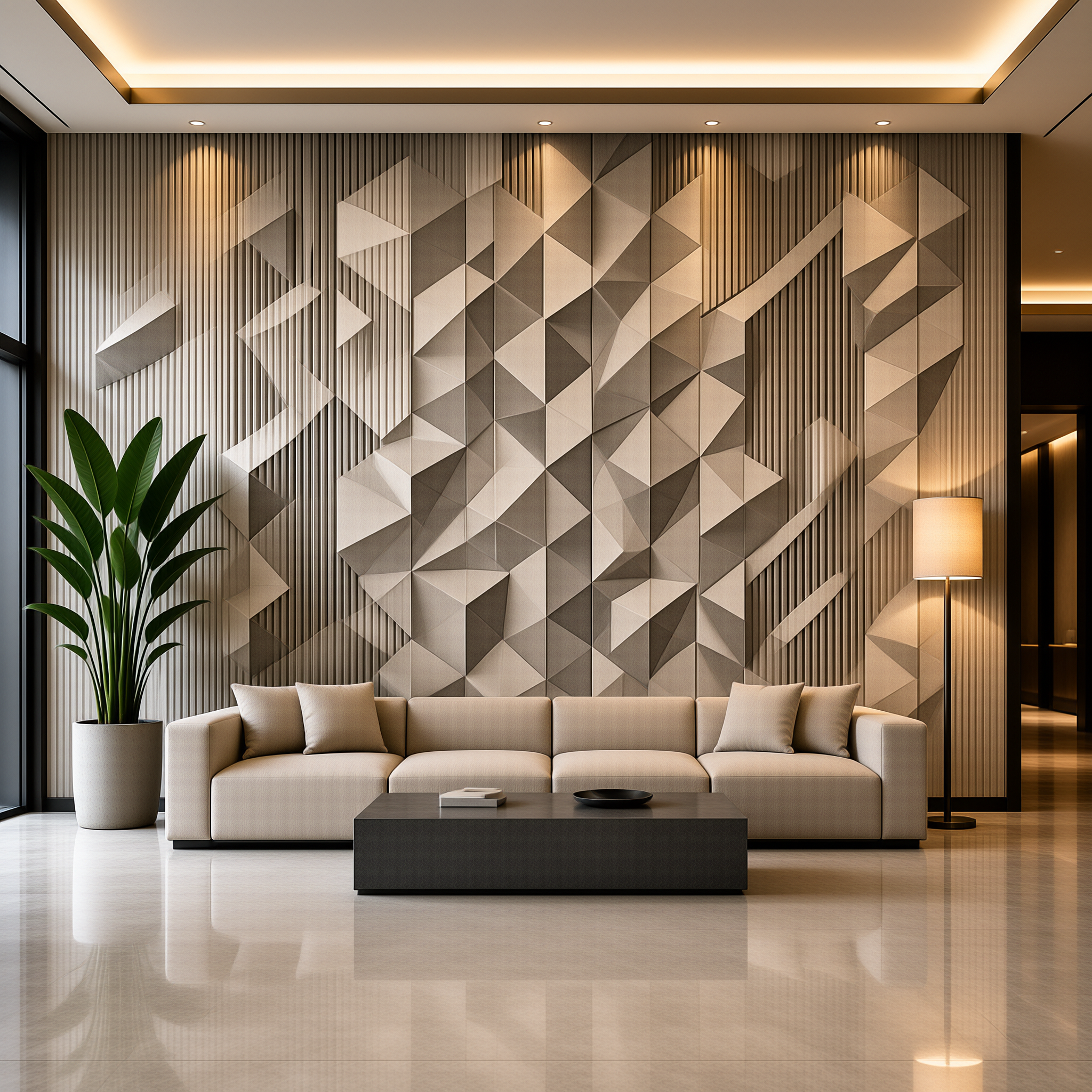
Applications of 3D Effect Wallpaper in Hotels and Commercial Interiors
Hotels and commercial interiors are where viewing distance matters most. A lobby backdrop is read from several metres, while a corridor wall is read from a metre or less. 3D effect wallpaper for hotel interiors should be selected with that distance in mind rather than from a swatch on a desk.
| Space | Typical viewing distance | Pattern guidance |
|---|---|---|
| Hotel lobby, reception backdrop | 3 to 10 m | Larger motifs, stronger tonal contrast, several complete cycles across the width |
| Corridors, lift lobbies | Under 2 m | Smaller repeats, moderate contrast, repeat aligned to door modules |
| Restaurant or bar feature wall | 1 to 4 m | High-contrast geometric prints, checked against seat and signage height |
| Office reception | 2 to 6 m | One strong wall, tonal or controlled contrast |
| Workstations, meeting rooms | Under 3 m | Low-contrast gradient or fine geometric to avoid visual noise |
| Residential feature wall | 1 to 5 m | One optical wall per sightline |
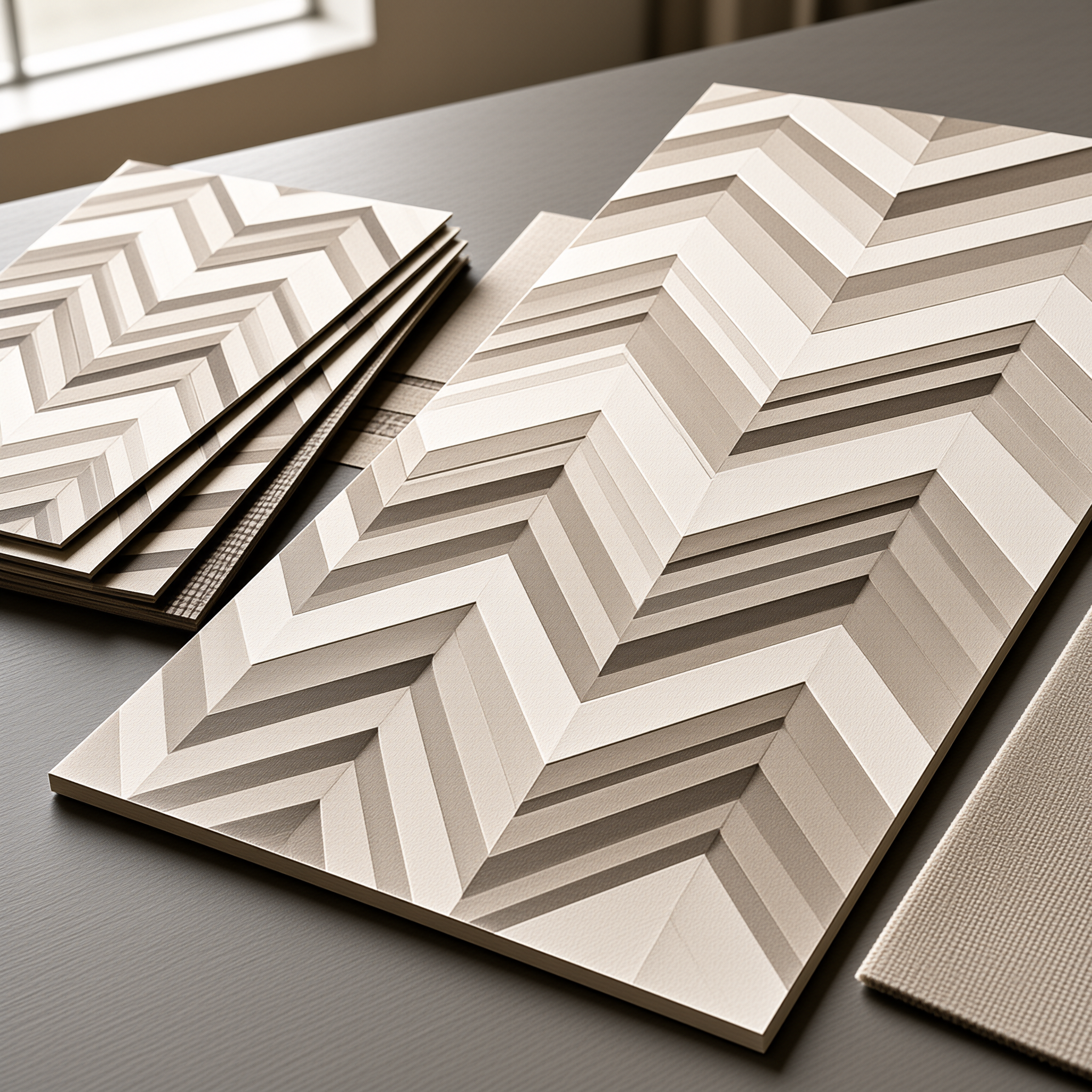
Room type does not determine fire, acoustic or durability performance. Those come from the specified substrate and finish, so check the available wallcovering material types against the project requirements rather than inferring performance from the pattern. Our guide to commercial wallcovering for hotels covers that layer of specification in more detail.
In most projects, one optical wall per sightline is a practical rule. Two competing dimensional walls in the same view cancel each other out, and the weaker one starts to read as a mistake rather than a decision. If you want precedents for how a single dimensional wall behaves in a real interior, ArchDaily publishes hotel and commercial projects worth comparing.
How Do You Choose the Right Pattern for a Feature Wall?
Start with the wall's job, not the pattern. A focal wall should carry contrast or a strong motif because it is meant to be looked at. A backdrop wall should stay tonal so the depth reads as atmosphere and does not compete with furniture, art or signage. Deciding which one you are buying narrows the shortlist quickly.
A workable scale rule: keep motifs large enough to complete several visible cycles across the wall width. On a four-metre wall, a motif that fits only once or twice reads as a wall graphic. Counting motif cycles on an elevation drawing takes a few minutes and prevents most scale errors before they reach print.
Tonal palettes soften the illusion and suit quiet spaces such as treatment rooms or executive offices. Higher contrast strengthens perceived depth but magnifies any seam misalignment, because adjacent panels have to match more precisely. Where the installation team is new to the material, moderate contrast is the safer specification.
Map the fixed elements before artwork approval. Door frames, sockets, vents, signage and corner returns will all cut through the pattern, and marking them on the elevation tells the artwork team where to shift the repeat. Approve a full-scale printed proof wherever the budget allows instead of judging depth from a screen.
Printed 3D Effects vs. Textured Wallcovering Materials
Printed 3D effects and textured wallcoverings solve different problems. In a printed design, the depth is artwork on a flat surface, the repeat and scale are set at design stage, and the visual effect looks broadly the same regardless of light direction. Physical texture is a separate discipline, covered in our guide to textured wallpaper as a luxury wallcovering category.
Embossed or expanded wallcovering carries relief formed in the material itself. The pattern responds to raking light and changes through the day as the sun moves, which can be striking in a space with strong side light and flat in a space lit only by downlights. It is a different design choice, not a stronger version of the printed effect.
Rigid dimensional panels have genuine geometry. They bring weight, jointing and substrate requirements that sit outside a roll wallcovering, and they install on a different sequence. Hybrid products combine a print with a light emboss, so treat them as a third category and check both behaviours at sample stage.
Mis-specification usually happens at that sample stage. A buyer feels a textured sample and assumes the printed range has the same hand, or approves a print expecting it to catch light across the room. Confirm in writing which behaviour you are buying, then view the sample under the lighting the room will actually have. Where the project sits in the contract bracket, the premium commercial wallcovering ranges show which constructions are built for that use.
Custom 3D Effect Wallpaper for Interior Design Projects
Custom work follows a predictable sequence. The brief fixes the pattern family, the wall dimensions and the viewing distance. Artwork is then built at final scale so the repeat count is confirmed before printing, and the panel layout is drawn to the real elevations, including doors and corner returns. This is where most dimensional wallpaper for feature walls is either made or broken.
Proofing and sample approval come next. Approval should be against a printed proof at final scale or a physical strike-off, not a screen image, because colour and gradient banding behave differently on substrate. Panel heights and widths are confirmed at the same stage, along with the panel count per wall.
VELORA is a custom wallpaper manufacturer working with interior designers, architects, hotel FF&E and procurement teams, and professional distributors. The company supports decorative pattern development, custom printing, material selection, sampling and project-based production, including OEM and ODM work for brands and contractors. The custom wallcovering OEM and ODM service page sets out how a project moves from design brief to production.
When you write the specification, confirm these points in the purchase order:
Depth type: printed, embossed, or hybrid.
Substrate and finish, with any performance requirement stated against the material.
Repeat size and pattern scale at the final wall width.
Panel or drop height and width, with panel count per wall.
Proof and sample approval stage, agreed in writing.
Frequently Asked Questions
- What is 3D effect wallpaper?
- It is a flat wallcovering printed with artwork designed to look three-dimensional. Perspective, shading and layering do the work, so the surface stays smooth even though the wall appears to have depth.
- Does 3D wallpaper physically protrude from the wall?
- Printed 3D effect wallpaper does not. Some products sold under the same name are embossed or are rigid panels, so ask the supplier to confirm which type you are buying before approval.
- Is 3D effect wallpaper suitable for hotel interiors?
- Yes, when the pattern is chosen for the real viewing distance. Lobbies carry large motifs well, corridors need quieter repeats, and the substrate still has to meet the project's performance requirements.
- How do you choose the right 3D wallpaper pattern for a feature wall?
- Decide whether the wall is focal or backdrop, then size the motif to complete several cycles across the wall width. Map fixed elements and approve a full-scale proof before production.
- Can 3D wallpaper designs be customized?
- Yes. Custom manufacturers build artwork at final scale, set the repeat to the wall and print to project dimensions. Sampling and printed proofs are normally part of that process.
- Does lighting change how a printed 3D design looks?
- Less than it changes an embossed one. Printed shading is fixed in the artwork, though substrate sheen and gloss can still shift how strong the contrast appears.