The distinction between waterproof vs water-resistant wallpaper decides how hotel bathrooms should be zoned and specified, from seams to adhesive and primer.
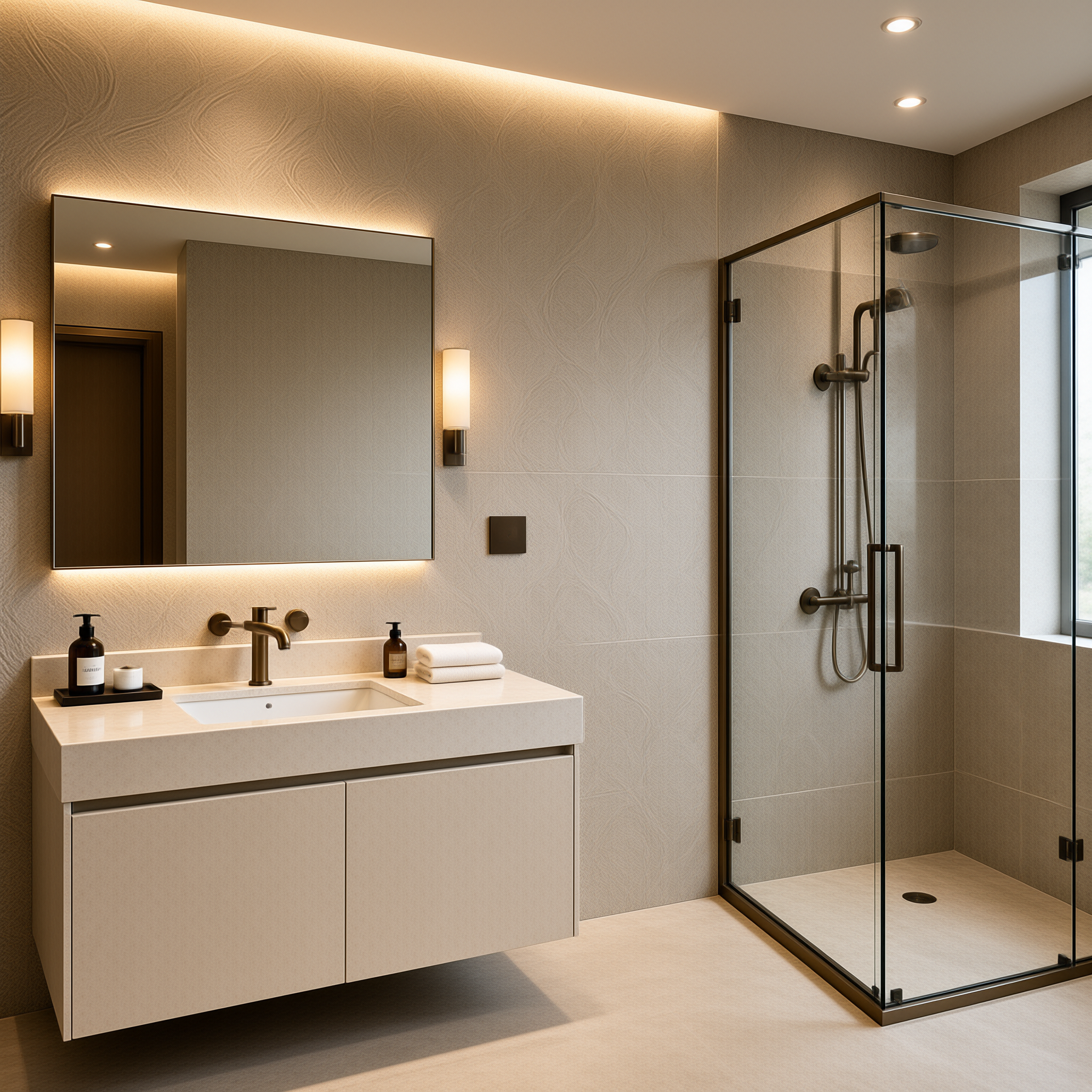
Waterproof vs water-resistant wallpaper is the distinction that decides whether a bathroom wall specification survives the room it is installed in. Waterproof describes an assembly that resists water movement across the face, the seams and the substrate; water-resistant describes a surface that tolerates limited moisture contact without immediate failure.
The two claims are not interchangeable, and suppliers should not be allowed to use them as if they were. A water-resistant face can sit on a moisture-sensitive backing, and a waterproof-rated film can still leak at an unsealed seam or an unprimed substrate.
The claim belongs to the installed assembly, not to the printed sample.
Key Takeaways
Waterproof describes a closed assembly; water-resistant only describes surface tolerance to limited moisture.
Specify tile or solid surface inside the shower enclosure — wallcovering belongs outside the wet line.
Seams, adhesive and primer cause more bathroom wall failures than the decorative face layer.
Scrub-cycle rating and water resistance are separate axes; a high scrub count is not a waterproof claim.
Ask for substrate type, seam treatment and written warranty exclusions before issuing the purchase order.
Why 'Waterproof' and 'Water-Resistant' Are Not the Same Claim
Waterproof is an assembly claim and water-resistant is a surface claim. The first says water cannot pass through the finished wall; the second says the facing tolerates limited moisture contact without immediate damage.
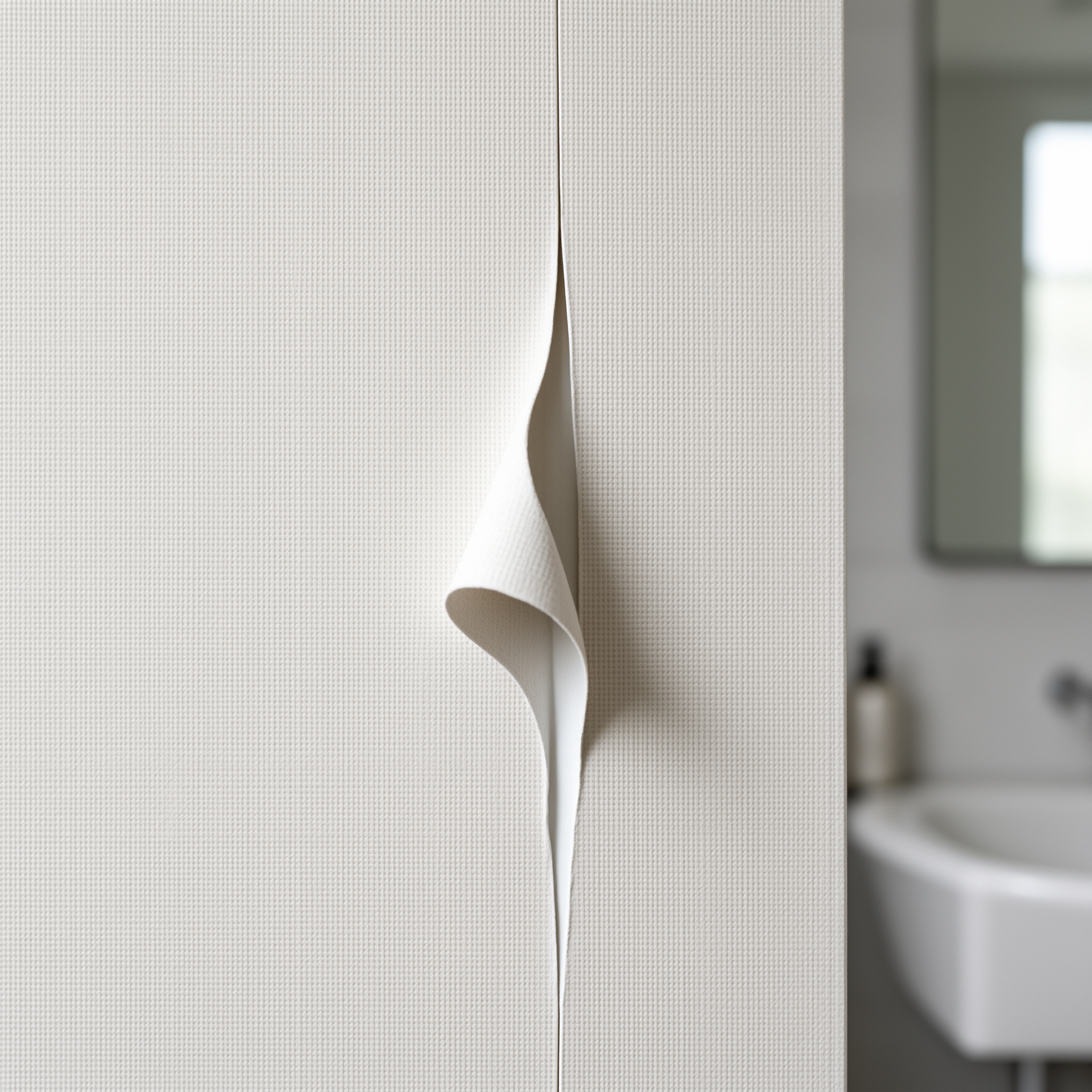
Vinyl and coated films are closed-cell, so droplets bead on the surface and moisture vapor passes slowly. The layers behind that film are often not closed. Paper and some non-woven substrates wick liquid sideways through their fibre structure, which is why a small seam gap can saturate a panel edge well beyond the visible wet mark.
Across a cross-supplier review of published Type II commercial wallcovering datasheets, water resistance is listed as a film property while scrub cycles appear as a separate cleaning metric, commonly quoted between 1,000 and 100,000 cycles. Neither figure describes behaviour at an unsealed seam next to a shower.
A waterproof wallpaper claim supported only by a film test has not tested the wall.
Waterproof vs Water-Resistant vs Washable: A Side-by-Side Comparison
In hospitality wallcovering, washable, water-resistant and waterproof answer three different questions. Washable covers cleaning tolerance, water-resistant covers humidity tolerance, and waterproof covers resistance to water movement through the whole build-up.
The three properties live in different layers. A scrubbable finish is a face-coating property, and cross-linked acrylic or vinyl films resist abrasion from cleaning agents. Specifying water resistant wallpaper on the strength of a scrub count confuses a cleaning metric with a moisture barrier, because water resistance depends on how tightly the film and the backing shed liquid together.
In a cross-supplier review of Type II commercial wallcovering datasheets, scrub-cycle ratings are quoted from roughly 1,000 to 100,000 cycles while water resistance is reported as a separate line item (published manufacturer technical data, cross-supplier review). ISO wallcovering standards treat washability and substrate performance as separate test families, and hospitality wallcovering specifications should read them the same way.
| Property | Washable | Water-Resistant | Waterproof (documented) |
|---|---|---|---|
| What it describes | Surface cleaning tolerance | Limited moisture contact | Water movement through the build-up |
| Layer responsible | Face finish or coating | Face film plus backing | Face, backing, seams, adhesive, primer |
| Typical datasheet evidence | Scrub cycles (1,000–100,000) | Film water-resistance line item | System-level test of a seamed assembly |
| Common failure mode | Abrasion or gloss loss | Edge swelling, seam lifting | Unsealed penetrations and joints |
| Suitable hotel zones | Vanity, toilet, dry walls | Vanity, toilet, outside-shower walls | Only where the full assembly is documented |
Washable does not mean water cannot enter the seam.
Water-resistant does not mean the substrate is mildew-resistant.
A waterproof film does not make a seamed wall waterproof.
A high scrub-cycle rating is a cleaning metric, not a moisture barrier.
Scrub cycles and water resistance are separate axes — quoting one to justify the other is a specification error.
Hotel Bathroom Zoning: Where Direct Water Meets the Wall
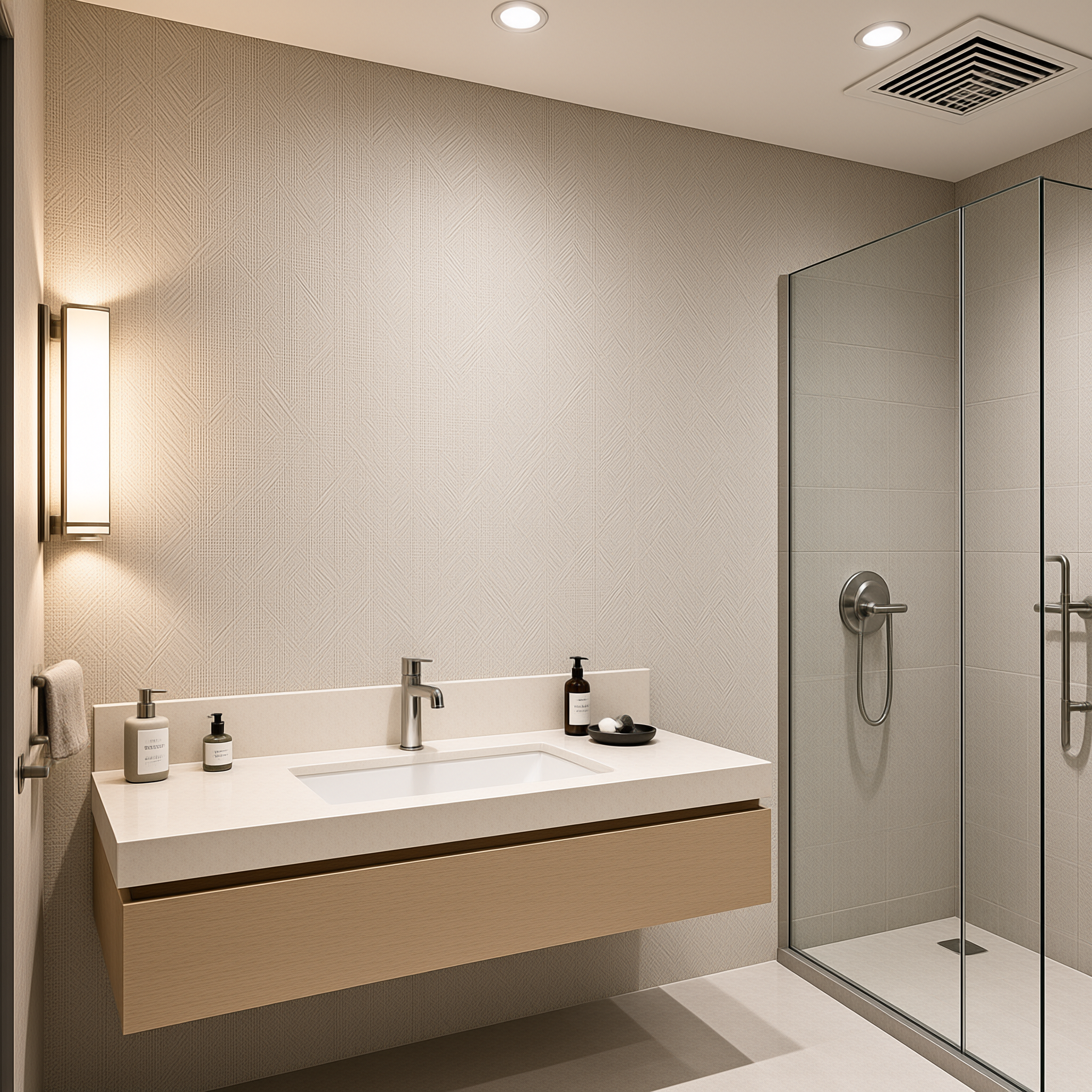
Hotel bathrooms split into three specification zones: the direct wet zone inside the shower or tub enclosure, the splash zone at the basin and toilet, and the dry-humidity zone on the remaining walls.
Water reaches a wall in two different ways. Direct spray delivers liquid under pressure to a small area, while humidity condenses across every cool surface in the room. Hotel bathroom wallpaper handles the second well and the first poorly, because condensation sits on the surface and evaporates, whereas driven spray finds the seam line and panel edge first.
A 220-key upper-upscale property shows the split in practice: the designer wanted the pattern to run behind the basin and across the toilet wall, while the contractor flagged seam failure and warranty exclusions near the tub and shower. The resolved specification kept wallcovering outside the wet line and specified tile inside the enclosure.
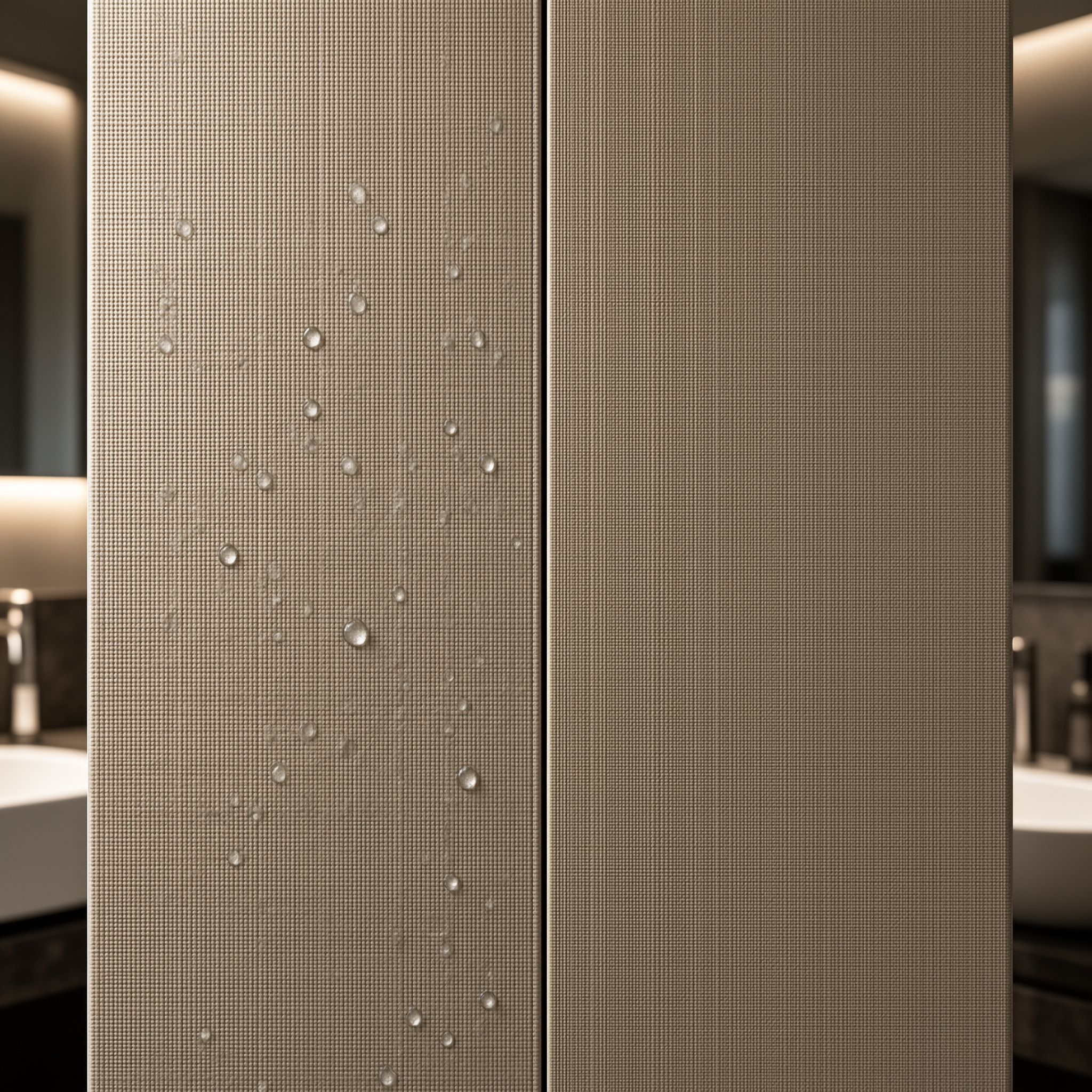
Condensation is a finish problem; driven spray is an assembly problem.
What the Construction Stack Has to Do: Face, Backing, Seams, and Adhesive
Five layers decide whether a bathroom wallcovering survives humidity: face film, backing, seam treatment, adhesive and primer. A high-performing face on the wrong backing still fails.
Moisture travels along the path of least resistance, which is usually the seam and then the backing. Acrylic-backed and non-woven substrates swell at the cut edge before they delaminate, and once an edge lifts, water enters the panel from the side rather than the face. Face abrasion results therefore predict how a bathroom wallcovering behaves in service only weakly.
A 1,000-cycle scrubbable finish and a 100,000-cycle finish fail identically at a seam that was never sealed. In our sampling reviews of submitted constructions, seam-edge behaviour separated acceptable samples from rejected ones far more often than face-film properties did (hands-on substrate and edge checks across multiple sampling rounds).
Seam performance separates acceptable samples from rejected ones more reliably than face properties do.
Specifying for Vanity, Toilet, and Outside-Shower Walls
Zone determines specification before aesthetics do. Wallcovering earns its place at the vanity, on the toilet wall and on the walls outside the shower enclosure.
Vanity Walls: Splash Zone, Not Wet Zone
A vanity wall receives splashes and cleaning agents, not standing water. Commercial bathroom wallpaper specified here needs a wipeable or scrubbable finish, a moisture-tolerant backing and sealed panel edges.
Choose paper-backed decorative paper only if the basin sits more than 600 mm from the wall and no wall-mounted tapware sprays sideways. Choose Type II vinyl or an acrylic-coated non-woven if the counter abuts the wall, if spray cleaners are used daily, or if housekeeping follows a chemical cleaning schedule.
Toilet Walls: Low-Splash, High-Humidity
A toilet wall sits in the humidity zone, not the wet zone. Air extraction matters more here than the finish itself, because moisture reaches this wall as airborne humidity rather than spray.
Choose a mildew-resistant substrate if the bathroom is windowless or extraction is intermittent. Choose a standard vinyl over a non-woven where extraction runs continuously and the door closes — the humidity load is then low enough that backing type becomes a secondary decision.
Walls Outside the Shower Enclosure: Define the Boundary
The boundary line matters more than the product name. Draw it at the shower frame, the tub apron or the glass return, and specify tile or solid surface on the wet side of that line.
On a recent hospitality-fit consultation, the design intent for continuous patterned wallcovering behind the vanity was preserved by limiting wallcovering to outside-shower walls and toilet walls, with tile specified inside the wet line — a boundary decision that kept warranty coverage intact on VELORA-supplied constructions. Choose the same split whenever a single warranty claim would cost more than the pattern continuity is worth.
| Wall zone | Exposure | Specify | Avoid |
|---|---|---|---|
| Inside shower or tub enclosure | Direct spray, standing water | Tile, solid surface, glass panels | Any wallcovering, whatever the claim |
| Vanity wall behind basin | Splash and cleaning agents | Scrubbable Type II vinyl or coated non-woven, sealed edges | Paper-backed decorative paper within 600 mm of the basin |
| Toilet wall | Airborne humidity | Mildew-resistant substrate, moisture-tolerant adhesive | Unprimed plaster or bare gypsum |
| Outside-shower wall, rest of room | Occasional condensation | Standard commercial wallcovering with sealed seams | Peel-and-stick film in regularly wetted corners |
Wall Preparation, Primer, and Adhesive: The Overlooked Variables
Most bathroom wall failures are installation failures. Primer compatibility, adhesive class and seam sealing decide whether a moisture-tolerant product performs as specified.
Adhesive needs a sound, sealed substrate to bond to. Bare gypsum and dusty skim coats absorb adhesive moisture unevenly, so the bond sets faster in some areas than others along the same panel. An acrylic primer seals the surface and equalises absorption, which keeps the adhesive open long enough to bond evenly at the seam.
In our sampling reviews across commercial bathroom wallpaper submissions, edge swelling at the seam — not face-layer failure — was the dominant rejection criterion before primer compatibility was checked (hands-on sampling review of submitted constructions with substrate compatibility checks).
Hotel Specification Checklist and Questions to Ask the Supplier
A usable hotel wallcovering specification lets a contractor verify performance without calling the supplier. If a claim cannot be checked from the document, treat it as unverified.
What to Put on the Specification Sheet
The sheet should name the system, not only the pattern: face film type, backing or substrate, adhesive class, primer requirement and seam treatment. Add the zone of application so the contractor knows where the material is allowed.
Fire performance, scrub cycles and warranty exclusions belong on the same page as the moisture claim, so the numbers are read together. Test references should trace to published methods such as ASTM International performance standards, not to an unqualified marketing term.
Face film type and backing or substrate
Adhesive class and primer compatibility
Seam sealing method for the specified substrate
Scrub-cycle rating with the test reference
Fire performance reference
Warranty duration and written exclusions by zone
Approved cleaning agents and prohibited ones
Replacement availability for future refurbishment
Questions to Ask Before Issuing the Purchase Order
Suppliers answer differently depending on how a question is framed. Ask about the installed assembly rather than the product alone.
Ask what happens at a seam, who carries the warranty if that seam fails, and whether the adhesive and primer named in the datasheet are the ones specified for the project. When the datasheet and the technical team give different answers, price that risk before ordering hotel bathroom wallpaper for humid zones.
What substrate is this product manufactured on?
Is water resistance claimed for the film or for a seamed assembly?
What seam treatment is required, and is it covered by the warranty?
Which adhesive and primer grades are approved for this backing?
What is the scrub-cycle rating and which method produced it?
Which zones of a hotel bathroom are excluded from warranty?
Which cleaning agents will damage the finish?
Can a matching replacement run be supplied for future refurbishment?
FAQ: Waterproof and Water-Resistant Wallpaper in Hotels
- Is waterproof wallpaper really waterproof?
- Only an installed assembly can be waterproof. A film that resists water does not make a seamed wall waterproof unless the backing, seam treatment, adhesive and primer close the wall as one system.
- What is the difference between washable and water-resistant wallpaper?
- Washable describes how the surface handles cleaning; water-resistant describes how the material handles moisture contact. They are separate performance axes and neither implies the other.
- Can you use wallpaper in a hotel bathroom?
- Yes — at the vanity, on the toilet wall and on walls outside the shower enclosure. Inside the direct wet zone, tile, solid surface or glass panels are the defensible specification.
- Can wallpaper go inside a hotel shower?
- Direct wet zones inside the enclosure generally require tile, solid surface or glass-panel systems. Wallcovering warranties commonly exclude submerged and directly sprayed areas.
- Is water-resistant wallpaper mold-resistant?
- No. Water resistance limits liquid penetration, while mildew resistance depends on substrate formulation and additives. Confirm both properties separately on the datasheet.
- How long does commercial bathroom wallpaper last?
- Lifespan depends on zone severity, substrate, seam quality and the cleaning routine. Poor extraction and aggressive chemicals shorten service life more than the material name does.
- What does scrubbable mean on a wallcovering spec sheet?
- It describes how the surface resists repeated cleaning abrasion, usually expressed in scrub cycles. It says nothing about water ingress at seams, edges or penetrations.
The wet line, not the product name, is the boundary that protects a hotel bathroom specification.
The decision comes back to drawing the wet line correctly and documenting every layer that has to hold it. If the pattern must run continuously, keep it outside the shower enclosure, prime for the substrate in use, seal the seams, and verify the assembly before the first roll is hung — that is the practical answer to waterproof vs water-resistant wallpaper in hotel projects.