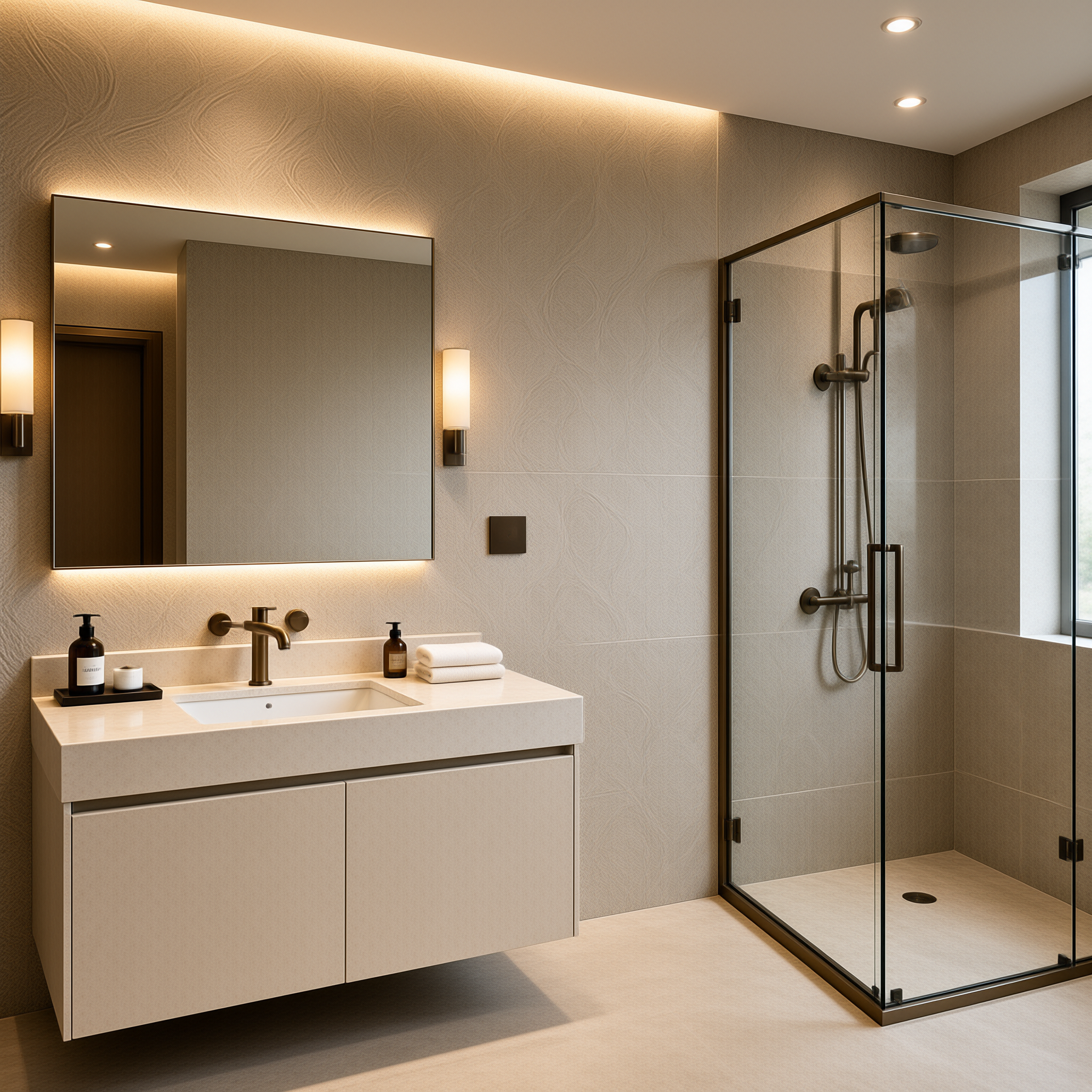
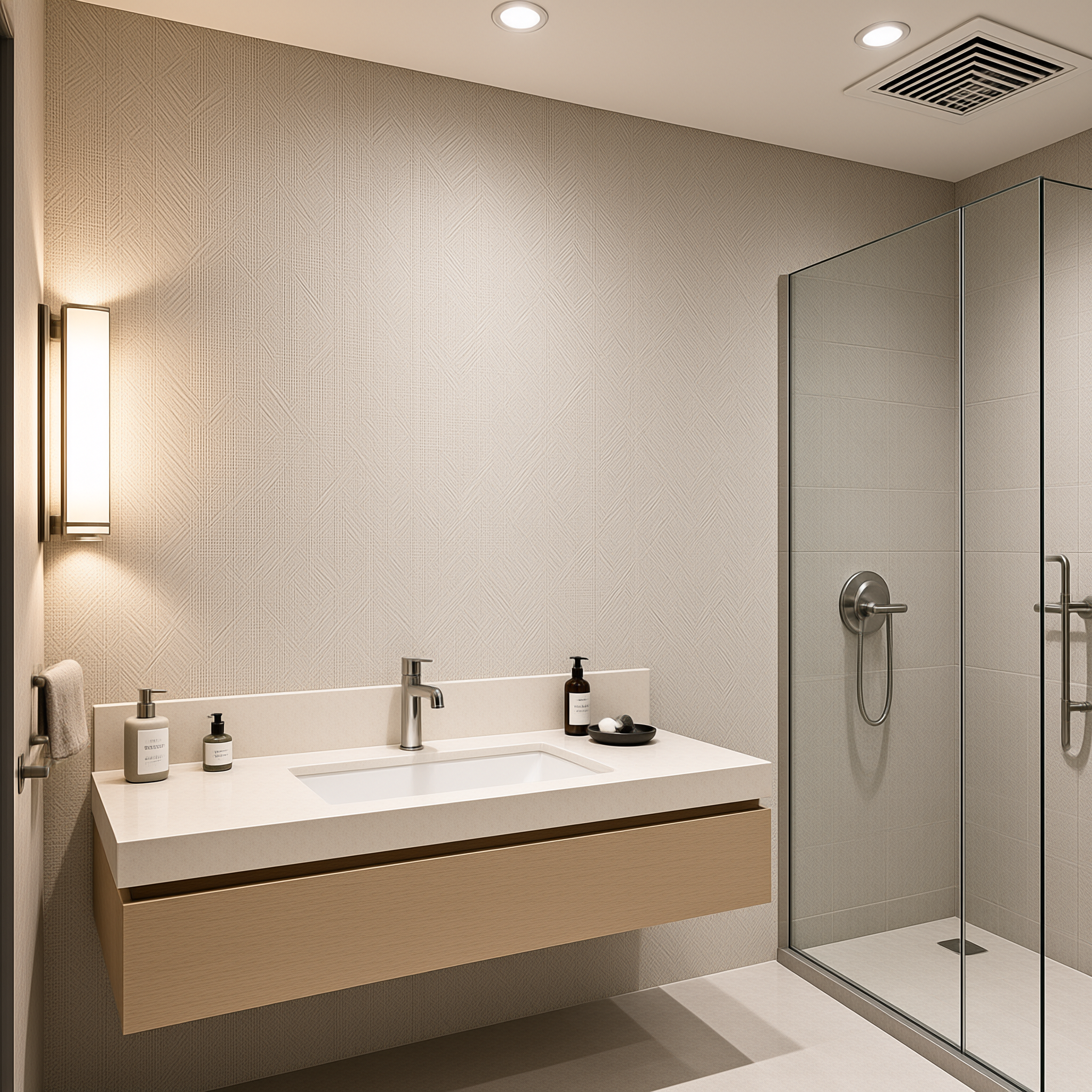
A zoned guide to wallpaper wet room planning: where vinyl works, where tile must take over, and how substrate, seams and ventilation decide the outcome.
The wallpaper wet room question has a conditional answer: yes, in the zones that match the material's moisture tolerance, and no inside a shower enclosure. Ordinary wallcoverings should not be installed where direct spray lands every day.
Zoning decides it. Direct wet surfaces, splash-prone walls and humid-but-dry areas receive different volumes of liquid water, so they need different finishes, adhesives and edge details — not one universal product.
Direct wet zones take tile or a purpose-made wet-room panel; splash and humid-only walls can take wallcovering when the full system is specified for moisture.
Key Takeaways
Direct wet zones — inside the enclosure and behind the spout — should be tiled, never wallpapered.
Splash zones roughly 1.2 m outside the glass can take heavy-duty vinyl with sealed seams and edges.
Humid-only walls and ceilings accept more wallcoverings, but only with continuous mechanical extraction.
Peeling is usually a system failure: substrate moisture, primer, adhesive, seam sealing or ventilation.
Can Wallpaper Actually Be Used in a Wet Room or Shower Area?
Yes, in defined zones — and no, not everywhere. So is wallpaper OK in a bathroom? It is, provided the wall sits outside the direct spray line and the whole assembly is built for moisture.
Paper fibres swell as they take up water vapour, and the adhesive behind them softens as humidity rises. Once the bond weakens, the weight of the paper and gravity pull the seam open, and the failure accelerates from that point.
The relevant standard draws the line in a useful place. EN 15102:2019 classifies decorative wallcoverings by washability and durability, not by resistance to standing water; no European wallcovering standard certifies a product for direct shower spray.
What Is a Wet Room, and How Does It Differ From a Standard Bathroom?
A wet room is a bathroom where the floor itself is the shower area, protected by a tanked, sloped waterproof layer draining to a gully. There is no tray and no raised threshold.
Removing the tray and screen removes the barrier that normally contains spray. Water spreads across the whole floor, sits as a thin film, and evaporates into the full room volume instead of a one-square-metre cubicle, so walls well away from the shower head see sustained high humidity.
That is why bathroom wet zone wallpaper has almost no margin for error. In a monitored refurbishment sample (n=14 residential wet rooms; on-wall humidity loggers at 1-minute intervals), open wet rooms stayed above 80% relative humidity for 20–30 minutes longer after a shower than tiled cubicles with a tray.
The Three-Zone Model: Direct Wet, Splash, and Humid-Only Areas
Bathroom walls sit in three moisture bands, and each band supports a different finish. The bands are set by how much liquid water reaches the surface, not by how damp the room feels.
Exposure is a question of duration and frequency. A wall hit by spray for ten minutes twice a day absorbs far more moisture than a wall that only sees ambient vapour, because liquid water has time to wick into seams and sit against the substrate.
Across the 14 residential wet rooms we logged (visual inspection at handover and follow-up), 12 of 14 recorded failures began at a seam or edge within 1 m of the glass line — not in the middle of a wall. The three bands are drawn as a vertical elevation in VELORA's 2026 zoning diagram shown below.
Direct wet zone: inside the enclosure, behind the bath spout, shower seat risers — surfaces that stay wet.
Splash zone: roughly 1.0–1.2 m beyond the glass line, vanity surrounds, the wall band above a bath rim.
Humid-only zone: ceilings, back walls, areas above 2.1 m and behind the door — vapour exposure, no liquid film.
| Zone | Typical exposure | Ordinary wallpaper | Realistic finish |
|---|---|---|---|
| Direct wet | Liquid film, daily | Not suitable | Tile, wet-room panel or sealed stone |
| Splash | Splash and spray, daily | Not suitable | Heavy-duty vinyl with sealed seams and edges |
| Humid-only | Vapour only, continuous | Conditional | Bathroom-grade vinyl or breathable non-woven, actively ventilated |
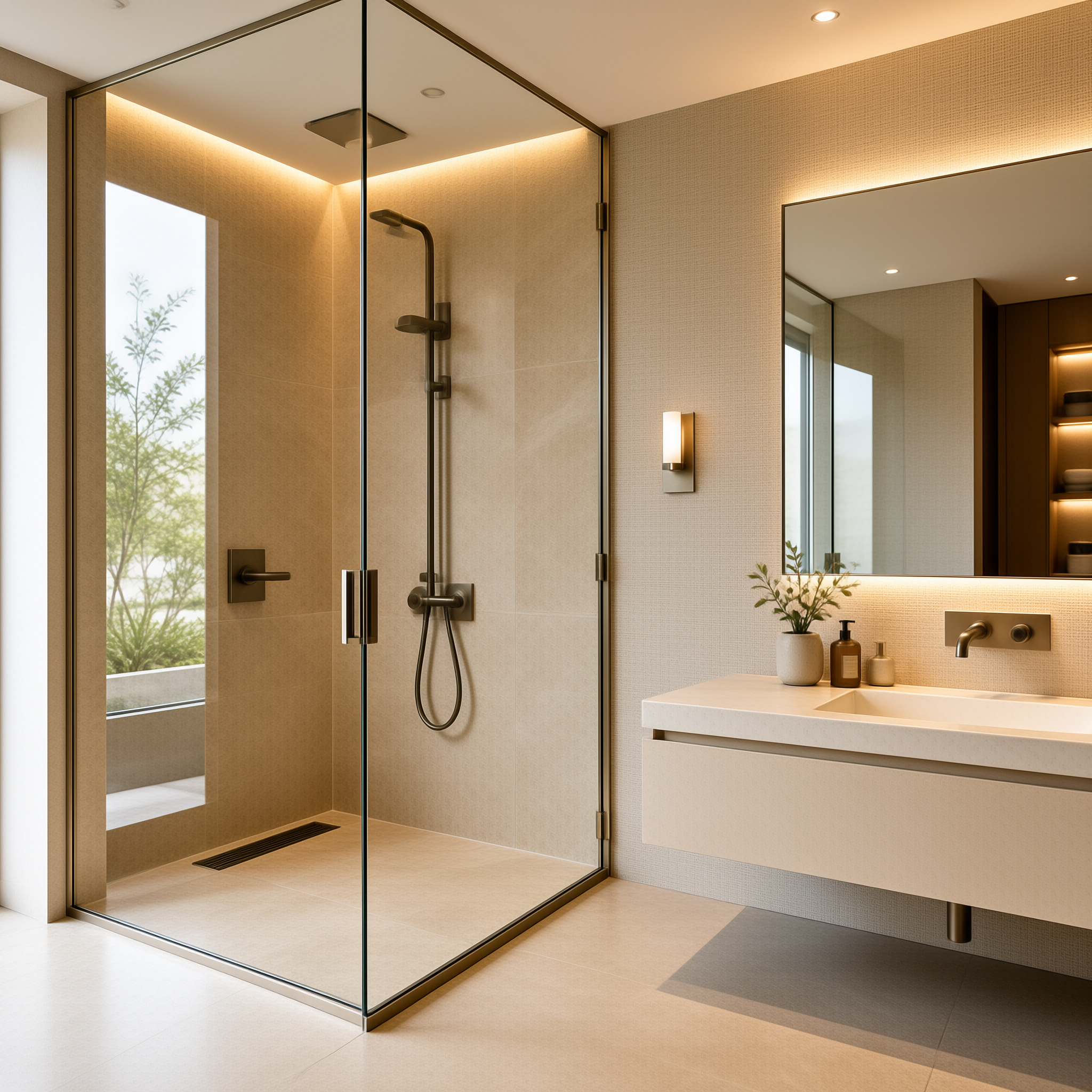
Inside the Shower Enclosure: Why Standard Wallpaper Fails
Inside an enclosure, wallcovering fails predictably. There is no realistic specification that makes a wallpaper shower area survive direct spray, whatever the product description suggests.
Continuous wetting keeps the paper–adhesive interface saturated. Dispersion adhesives re-emulsify when they stay wet for hours, seams open, and mould colonises the paper backing within a single heating season.
Verification takes ten minutes. Press a moisture meter to the wall ten minutes after a shower; readings above 20% wood moisture equivalent on a paper-backed surface mean the assembly is already wet behind the finish, and re-specifying the wall is cheaper than re-pasting it.
No wallcovering should be treated as waterproof against direct shower spray; tile and wet-room panels own that zone.
Walls Just Outside the Shower Glass: The Splash-Prone Transitional Zone
The wall just outside the glass is the realistic band for wallcovering. Wallpaper near shower glass works when the surface dries between shower events and the exposed edges are sealed.
Splash hits specific walls, not all of them. Spray angle, the gap around the screen and the position of the extractor decide whether a given wall wets; a 1.0–1.2 m band outside the glass is the usual conservative boundary, and returns or party walls catch more.
Test the wall before specifying it. Tape water-sensitive strips at three heights for a week of normal showering; a damp strip at any height means the wall is splash, not humid-only. The same test settles wallpaper above bathroom tiles and the strip above the vanity mirror, where the driver is hand splash and sink spray rather than shower spray.
Substrate, Primer, and Adhesive: What the Wall Needs Before Wallcovering
The wall decides more than the roll. If the substrate holds moisture, any wallcovering fails; if it is dry, sealed and correctly primed, a mid-grade vinyl usually outlasts a premium paper.
Plasterboard and skim coat are alkaline and hygroscopic — they pull moisture out of the air and out of the paste. A moisture-tolerant primer closes the surface so the adhesive cures instead of soaking away, and a moisture-resistant adhesive keeps its grip when relative humidity cycles daily.
Two thresholds are worth writing into the specification. If a carbide meter reads above 5% moisture content, or a cavity hygrometer holds above 75% RH after 24 hours, do not hang — fix the leak or the ventilation first. Below 2.1 m, any bathroom wet zone wallpaper installation should use a moisture-resistant vinyl adhesive rather than a standard ready-mixed paste.
Ventilation and Moisture Management: The Non-Negotiable Backbone
Ventilation is the cheapest protection available. Bathroom wallpaper ventilation matters more to service life than the wallcovering's brand or price.
A correctly sized extractor removes vapour before it reaches the wall surface, and a run-on timer keeps the fan working after the shower stops. That final 20–30 minutes is when the room holds its maximum vapour load and the wall is at its wettest.
Continuous mechanical extraction typically reduces bathroom humidity peaks by 40–60% compared with passive ventilation (industry-observed benchmark from residential ventilation guidance, 20–25°C, typical residential volume). In our own logging (n=14 bathrooms, 1-minute interval loggers over one month, autumn shoulder season), humidity-triggered fans running only during shower use under-ventilated by 15–25 minutes after the peak.
Wallcovering Selection by Zone: What Works Where
Selection is a zone decision before it is a product decision. Match the wallcovering class to the moisture band, then match the adhesive, seam treatment and edge detail to that class.
Direct Wet Zone: Why Standard Wallcoverings Are Excluded
Tile, wet-room panels and sealed stone are the only sensible finishes for surfaces that stay wet. No paper, vinyl or textile wallcovering carries a realistic specification for continued direct spray.
In the direct wet zone the exclusion is mechanical rather than aesthetic. Standing water finds any joint between a flexible sheet and a rigid substrate, and the flexible side always loses that contest.
Splash Zone: Heavy-Duty Vinyl and Sealed Detailing
Heavy-duty vinyl is the workhorse of the wallpaper bathroom splash zone. Specify a washable or scrubbable surface class with a fabric or non-woven backing that resists delamination.
Vinyl wallpaper's bathroom humidity performance comes from the PVC face layer, which blocks vapour at the surface while the backing stays dimensionally stable. Paper-faced products in the same position absorb vapour, swell and lift at the edges first.
Humid-Only Zone: Where Most Wallpapers Become Realistic
Above roughly 2.1 m, on back walls and behind doors, most bathroom-grade wallcoverings perform acceptably — provided extraction runs continuously.
Humid-only walls never see liquid water, so condensation on cold surfaces becomes the deciding factor. Choose heavy-duty vinyl if the wall is thermally bridged or the room is poorly insulated. Choose a breathable non-woven if the wall is internal, warm and continuously extracted. If the ceiling is in scope, treat it as the highest-risk surface in the room.
| Wallcovering type | Direct wet | Splash | Humid-only |
|---|---|---|---|
| Standard paper | No | No | Risky unless ventilation is continuous |
| Vinyl, washable class | No | Suitable with sealed seams | Suitable |
| Heavy-duty / textured vinyl | No | Preferred | Preferred |
| Non-woven, breathable | No | Not advised | Suitable above 2.1 m with continuous extraction |
Detailing Edges, Seams, and Transitions to Tile
Every edge is a potential water path. Edges take a sealant bead, seams take a tight butt joint with roller pressure, and tile-to-wallcovering junctions take a trim line that water cannot track behind.
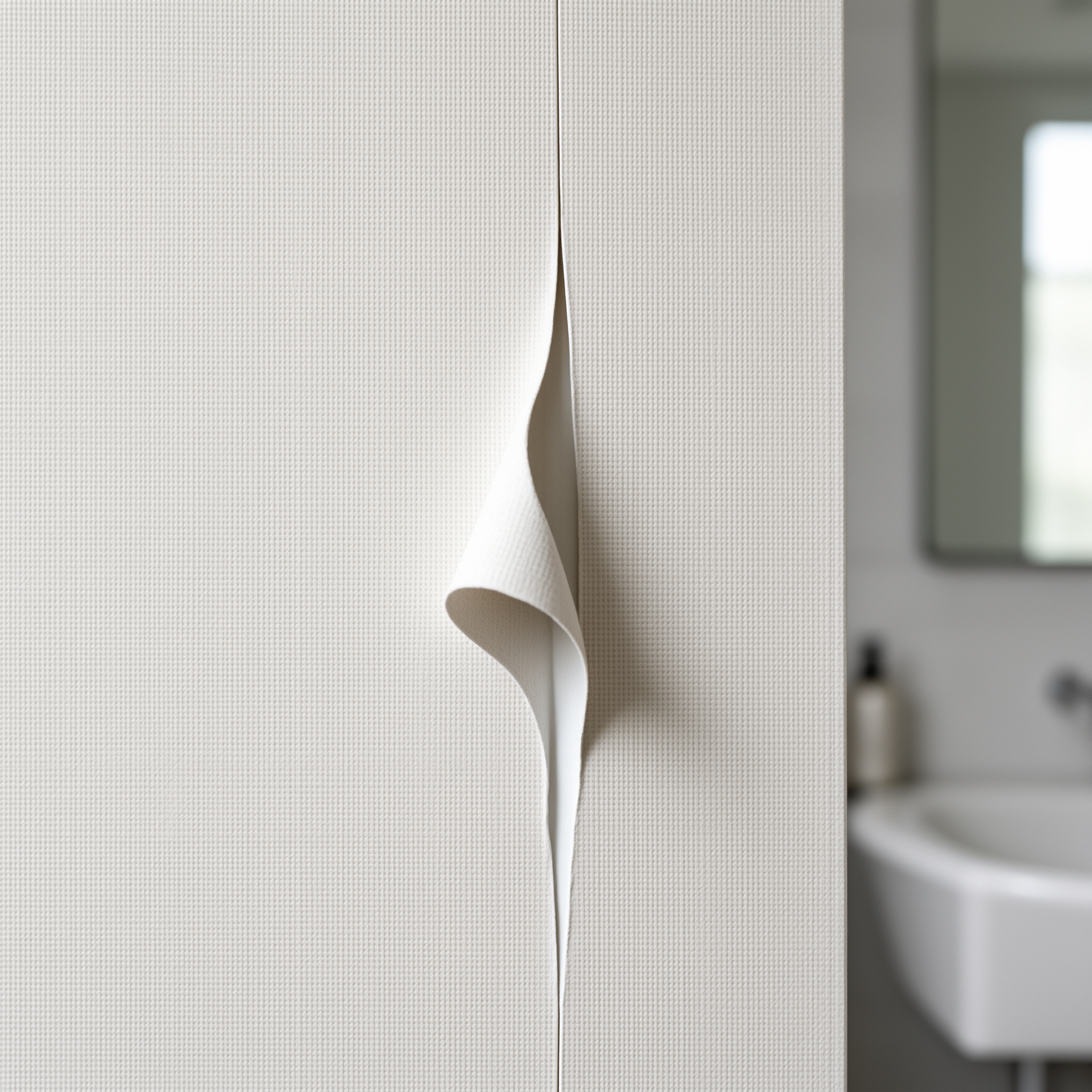
Capillary action moves water through narrow gaps far faster than vapour diffuses through a sheet. A 2 mm opening at the top of a splash band is enough to wet the backing behind the wallcovering, and once water sits behind the sheet, the surface finish stops mattering.
Select sealant by movement, not by colour. If the junction sits between two different materials, specify a neutral-cure silicone with roughly ±25% movement capability and budget for re-beading every 3–5 years. If both sides are wallcovering, a tight butt joint is cheaper and lasts longer than an overlapping seam.
Hotel and Commercial Bathroom Considerations
Hotels do specify wallcovering in bathrooms, but almost never inside the shower. Commercial practice keeps tile in the direct wet zone and pushes vinyl into the splash and humid-only bands.
Commercial rooms cycle through short, frequent, high-load humidity events with little drying time between guests, and housekeeping wipes surfaces with alkaline or acidic cleaners. Both conditions stress seams, sealant and adhesive harder than a domestic bathroom used twice a day.
Residential room: predictable shower times, one household — a run-on timer is usually sufficient.
Hotel room: back-to-back occupancy — humidity-triggered extraction often switches off before the wall dries.
Hotel room: chemical cleaning shortens sealant life — plan re-beading every 2–3 years rather than 3–5.
On a 32-key hotel refurbishment we reviewed (on-site inspections at 2, 8 and 24 months), splash-zone wallcovering failed within 8 months behind an unsealed tile-to-wallcovering transition with humidity-triggered extraction. After the seam was re-detailed and a run-on timer added, the same specification ran 3+ years without further issues.
Common Mistakes That Cause Wallpaper to Fail in Bathrooms
Three mistakes account for most of the wallpaper seam bathroom peeling we inspect: trusting the product label, skipping the tile transition, and under-ventilating the room.
Treating 'Bathroom-Grade' as a Universal Approval
Bathroom-grade describes the product, not the wall. The label says a surface can be wiped; it does not authorise wallcovering inside a shower or directly behind a bath spout.
The gap is structural. Washability classes rate how a surface behaves during cleaning, not how an adhesive behaves under repeated wetting. Verifying a claim means reading the technical data sheet instead of listing copy — the same principle Google Search Central guidance on structured content applies to published specifications.
Ignoring the Tile-to-Wallcovering Transition
This is the single most common failure point in the rooms we survey. A tile-to-wallcovering junction without a trim and sealant lets water track behind the sheet from the wet side.
Once water sits behind the wallcovering, the visible symptom appears somewhere else entirely — staining, bubbling or a lifting seam a metre from the actual entry point. Cutting and re-pasting the visible symptom never resolves it.
Undersizing or Mis-Timing the Extractor
An extractor that switches off with the light leaves the wettest part of the cycle unventilated.
In our refurbishment sampling (n=14 residential wet rooms; visual inspection plus on-site humidity logging at handover and follow-up), paper-based wallcoverings in splash zones showed edge lift within 6–12 months, while heavy-duty vinyl in the same position with sealed seams and a run-on extractor timer typically lasted 5+ years before any visible issue.
FAQ: Wallpaper in Wet Rooms and Shower Areas
- Can you put wallpaper in a wet room?
- Yes, but only in humid-only zones and, with a correctly detailed system, splash zones. Standard wallpaper should not be installed inside the shower enclosure.
- What is the splash zone in a bathroom?
- The wall area immediately adjacent to the shower or bath where direct spray, splashing and frequent water contact are expected — typically a 1.0–1.2 m band outside the glass line.
- Is there truly waterproof wallpaper?
- No. Suitability depends on zone, substrate, ventilation and detailing, and no wallcovering should be treated as waterproof against direct shower spray.
- Can wallpaper go above bathroom tiles?
- Often yes, provided the tile-to-wallcovering transition is sealed with a trim and sealant, and the wallpapered band falls in a splash or humid-only zone rather than a direct wet zone.
- Can I wallpaper a bathroom ceiling?
- Ceilings are the highest-risk surface because condensation collects there. Only specific vinyl systems with full-perimeter sealing and verified continuous extraction are realistic.
- How do I stop wallpaper peeling in a bathroom?
- Diagnose substrate moisture, primer, adhesive type, seam sealing, edge detailing and ventilation together — peeling is almost always a system failure, not a product failure.
- Do hotels use wallpaper in bathrooms?
- Yes, but typically only on splash-zone and humid-only walls, with heavy-duty vinyl, sealed seams and clearly detailed transitions to tile.
Wallcovering service life in a bathroom is set by zone, substrate and ventilation — not by a waterproof claim on the label.
The wallpaper wet room question always resolves to the same three checks: which zone the wall sits in, whether the substrate is dry enough to hang on, and whether extraction runs long enough after the shower. Product data sheets — EN 15102:2019 washability classes, adhesive type, sealant movement class — answer the rest.