Bathroom wallpaper ventilation decides whether a windowless bathroom can hold wallpaper. Here's how substrate, wallcovering and placement work together.
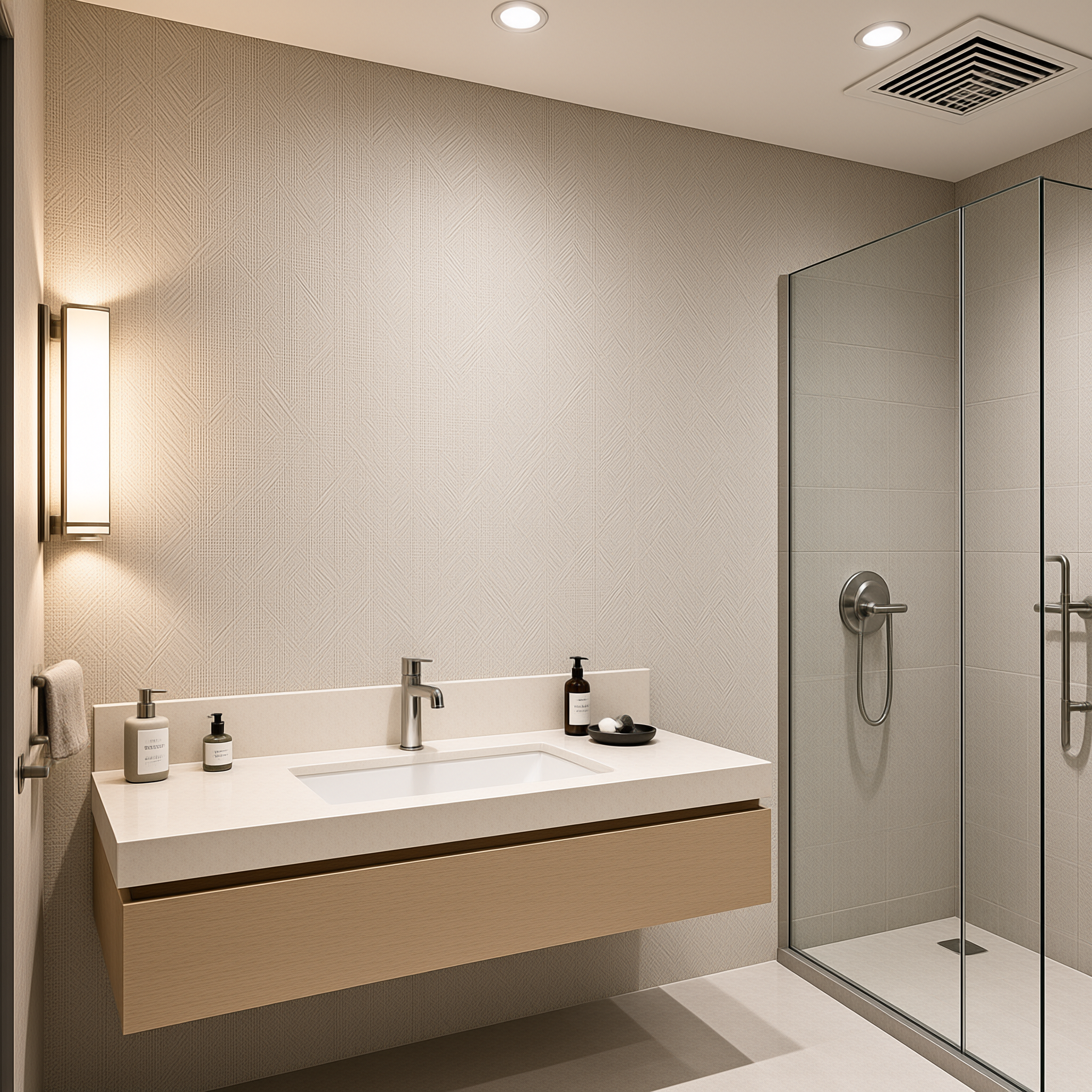
Yes, wallpaper can be installed in a bathroom with no window or poor ventilation, but only when four conditions are met: a dry, primed substrate; a vinyl-faced or otherwise humidity-stable wallcovering; an adhesive matched to both wallcovering and substrate; and placement away from direct water contact.
Persistently high relative humidity can shorten the service life of wallcoverings, particularly when the room does not dry adequately between uses. Ventilation, substrate condition, wallcovering construction and installation quality should therefore be considered together., whatever its label claims. Bathroom wallpaper ventilation — not product choice alone — is usually the deciding variable, and that is why extractor capacity, door undercuts and drying cycles should be corrected before the paper goes up.
Wallpaper survives a windowless bathroom when relative humidity stays under 70% RH, not when a product label says waterproof.
Key Takeaways
Wallpaper works in a windowless bathroom only when ambient RH stays below 70% and the substrate is fully primed.
Vinyl-faced wallcovering on a stable backing tolerates humidity; paper-backed and foil types delaminate from behind.
Keep wallpaper out of the splash zone — placement controls failure more often than product choice.
An extractor run 20 minutes after each shower outperforms any 'bathroom-rated' wallpaper label.
Seam lifting starts at the top of the wall where warm air pools, not at the splash zone.
Can You Use Wallpaper in a Bathroom With No Window?
Yes — a wallpaper bathroom with no window can perform for years when six variables are controlled at once: moisture exposure, ventilation, substrate condition, wallcovering construction, adhesive system and placement.
Without a window, passive air exchange disappears, so moisture-laden air sits in the boundary layer against the wall instead of drifting out. Vapor then migrates through seams and edge joints by capillary action and reaches the adhesive long before the visible face shows any problem.
A 4 m² windowless en-suite with a single 15 l/s extractor, a plasterboard wall and existing emulsion paint shows visible condensation on cold mornings — the standard candidate. It can hold wallpaper if the shower is not sprayed directly onto the wall and the fan runs long enough after each use.
Why Ventilation Matters for Bathroom Wallpaper
Bathroom wallpaper ventilation controls how long moisture stays in contact with the wall. It is the single largest factor in how long the paper lasts, ahead of brand or price.
Still air holds vapor against the wall surface, where it diffuses through seams and edge joints into the adhesive layer. Air exchange removes that vapor before the wall drops below the dew point — the temperature at which condensation begins.
In a windowless bathroom, relative humidity can rise sharply during and after showering, especially when extraction is inadequate. The longer humid air remains in the room, the greater the risk of condensation forming on cooler wall surfaces and moisture reaching wallpaper seams or the adhesive layer.For this reason, ventilation performance should be assessed together with wall temperature, substrate condition and the construction of the wallcovering rather than relying on the surface finish alone.
Signs a Bathroom Has a Moisture or Ventilation Problem
Five signs point to a moisture problem: morning condensation on cold walls, a musty smell that returns after cleaning, darkening near the ceiling, a mirror that stays fogged past ten minutes after a shower, and lifting at existing seam lines.
Each symptom appears when the wall surface temperature drops below the dew point of the room air. Vapor condenses on the coldest available surface, and the resulting moist film feeds mould spores already present in household dust.
The practical test is a cheap hygrometer held 300 mm from the wall two hours after the last shower; a reading above 70% RH means the room is not drying out. Humid bathroom wallpaper cannot be specified safely until the room passes that check on a cold morning, when condensation risk peaks.
Mirror stays fogged more than 10 minutes after a shower
Condensation beads on exterior-facing walls on cold mornings
Musty odour returns within hours of cleaning
Existing paper or paint lifts along seam lines
Hygrometer reads above 70% RH two hours after use
Humid bathroom wallpaper fails behind the sheet first — edges lift and seams open weeks before the face shows any damage.
What Wallpaper Characteristics Matter in Poorly Ventilated Bathrooms?
Wallpaper for windowless bathroom projects should be judged on four characteristics: a wipeable face, a dimensionally stable backing, a mould-inhibiting adhesive, and a laminate that resists vapor movement through the sheet.
When humidity cycles, paper fibres swell and shrink while the vinyl face does not. That mismatch places shear stress on the bond between face and backing, which is exactly where delamination and seam movement begin.
Choose vinyl-faced wallcovering on a non-woven or polyester backing if the room has no window and no run-on timer fitted. Choose a standard non-woven on a primed wall only if an extractor runs 20 minutes after each shower. If neither condition can be met, tile is the cheaper long-run decision.
Vinyl, Non-Woven and Other Wallcoverings: What Changes in Humid Rooms?
Bathroom wallpaper humidity tolerance is set by the whole laminate, not the surface alone. The face determines wipeability; the backing determines whether the sheet stays flat as moisture cycles.
Vinyl-Faced Wallcoverings
A vinyl face resists surface water and wipes clean, so it suits walls adjacent to, but outside, the splash zone. On a paper backing, however, the vinyl face offers no protection from behind.
Vinyl on non-woven or polyester backing holds its dimensions better under cycling humidity, because the synthetic core does not swell. The tradeoff is strip-ability: these sheets are harder to remove later without damaging the substrate.
Non-Woven and Fleece-Backed Wallcoverings
Non-woven backings are dimensionally stable and paste-the-wall friendly, which reduces the water introduced during installation. They tolerate ambient humidity well but are not, by themselves, splash-resistant.
Fleece-backed products behave similarly. Neither backing blocks vapor, so mould risk behind the sheet still depends on the substrate being dry and properly primed before hanging.
Paper-Backed and Foil Wallcoverings
Paper-backed wallcoverings swell at the edges when ambient humidity rises, and the resulting curl opens seams. In a windowless room holding above 70% RH, edge lift usually appears first.
Foil and metallic finishes look striking but trap moisture at the laminate boundary, making them among the first to fail in humid rooms. Treat them as unsuitable for windowless bathrooms.
| Wallcovering | Humidity tolerance | Wipeable | Strips easily | Windowless bathroom use |
|---|---|---|---|---|
| Vinyl on non-woven or polyester backing | High | Yes | Moderate | General walls outside splash zone |
| Vinyl on paper backing | Moderate | Yes | Easy | Only with strong ventilation |
| Non-woven / fleece-back | Moderate | Partial | Easy | Primed walls with run-on extractor |
| Paper-backed | Low | No | Easy | Not recommended |
| Foil / metallic | Low | Partial | Moderate | Not recommended |
| Untreated textile | Low | No | Easy | Not recommended |
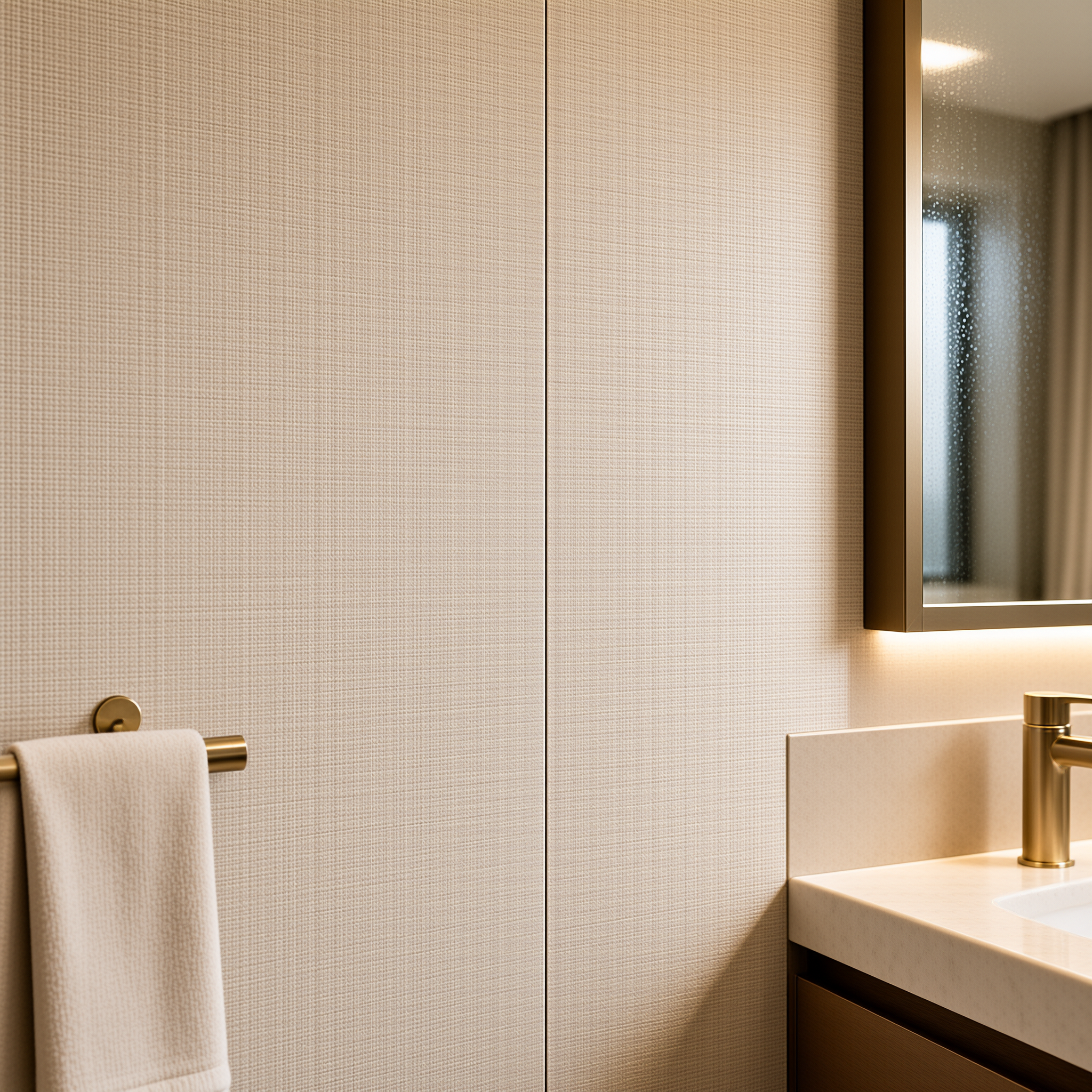
Where Wallpaper Should and Should Not Be Installed
Install wallpaper on walls outside the splash zone. Keep it out of shower enclosures, off the wall directly above a bath, away from the 600 mm behind a basin, and off ceilings above a steam source.
Liquid water reaches seams far faster than vapor does. A single splash deposits enough water to soften adhesive within hours, while the same wall might take months to fail under ambient humidity alone.
Many buyers wall the entire small room because tile feels heavier. The tradeoff is that even a splash-resistant wallcovering will fail at the seam closest to repeated water contact well before the rest of the wall does. For a wallpaper poor ventilation bathroom layout, that placement decision matters more than any surface rating.
How to Prepare the Wall Before Installation
Strip all old paper, fill and sand defects, let new plaster cure fully, then apply a dedicated acrylic wallcovering primer before hanging. Do not paper over existing emulsion.
Emulsion paint can re-emulsify under the water in wallcovering paste, so the adhesive bonds to a film that is itself moving. A primer seals the substrate and gives the paste a consistent surface to grip rather than one it soaks into.
Poor substrate preparation can contribute to adhesion problems in humid environments. Before installation, the wall should be dry, clean, smooth and properly prepared for the selected wallcovering and adhesive system.Always follow the wallcovering, primer and adhesive manufacturer's installation instructions, particularly when the installation area is exposed to recurring humidity.
Ventilation Improvements to Consider Before Wallpapering
Fit a correctly sized extractor, run it at least 20 minutes after every shower, cut a 10 mm door undercut, and add a humidity-sensing fan or dehumidifier where the room stays above 70% RH.
Continuous air exchange keeps the wall surface above the dew point, so vapor leaves the room before it can condense or diffuse into seams. A fan wired to the light switch does not achieve this, because it stops while the room is still wet.
Good ventilation, adequate drying time and proper substrate preparation can all help reduce moisture-related problems after wallpaper installation.Where a bathroom remains persistently humid after use, improve ventilation before installing wallpaper rather than relying on a moisture-resistant wallcovering alone.
Common Mistakes
Treating 'Waterproof' as Universal
No wallcovering is universally waterproof. A 'waterproof' label on the face says nothing about the backing, the adhesive or the seam — which is where failures actually start.
Water resistance applies to a cured surface under stated test conditions, not to an installed system in a room that never fully dries. Buyers who read the face rating and stop there usually get caught out.
Skipping Substrate Preparation
Hanging over existing emulsion or bare plasterboard is the most common cause of seam failure. Paste needs a sealed, uniform surface to bond consistently across the whole wall.
Skipping primer saves an afternoon and typically costs the wall. In humid bathroom wallpaper projects, the primer layer is often doing more work than the paper itself.
Papering Splash Zones
Wallpaper inside a shower, above a bath, or directly behind a basin will meet liquid water regularly. No decorative wallcovering sold for residential use is specified for that exposure.
Tile, glass or a waterproof panel belongs in those zones. Wallpaper belongs on the walls that only ever see vapor, and that distinction is the one that keeps a windowless bathroom looking finished for years.
Frequently Asked Questions
- Can you use wallpaper in a bathroom with no window?
- Yes, provided the substrate is dry and properly prepared, the wallcovering is suitable for humid environments, and the room has effective ventilation. Wallpaper should also be kept away from areas exposed to direct or repeated water contact.
- Does bathroom ventilation affect wallpaper?
- Yes. Ventilation affects how long humid air remains in contact with walls after showering. Poor drying conditions can increase the risk of condensation, seam lifting and adhesive-related problems over time.
- What wallpaper is suitable for a poorly ventilated bathroom?
- A vinyl-faced wallcovering on a non-woven or polyester backing, installed on a primed wall outside the splash zone. Avoid paper-backed, foil and untreated textile products.
- What happens to wallpaper when humidity remains high?
- Edges lift and seams open first, then the adhesive softens and mould can form at the substrate interface. Visible face damage usually appears last.
- Should ventilation be improved before wallpaper installation?
- Yes. Correct extractor sizing, a 20-minute run-on timer and a 10 mm door undercut are prerequisites, not optional upgrades.
- Where should wallpaper be avoided in a bathroom?
- Inside shower enclosures, directly above a bath, within roughly 600 mm behind a basin, and on ceilings above a steam source.
Bathroom wallpaper ventilation performance is decided before the first roll is ordered, not after installation.
Choosing wallpaper for a windowless bathroom is really a decision about moisture control, not decoration. Bathroom wallpaper ventilation, extractor run-on time and substrate preparation set the ceiling on how long any wallcovering lasts. Get those right first, then match the whole laminate — face, backing and adhesive — to the humidity the room actually sees. A room-specific humidity assessment before ordering is the cheapest step in the project.