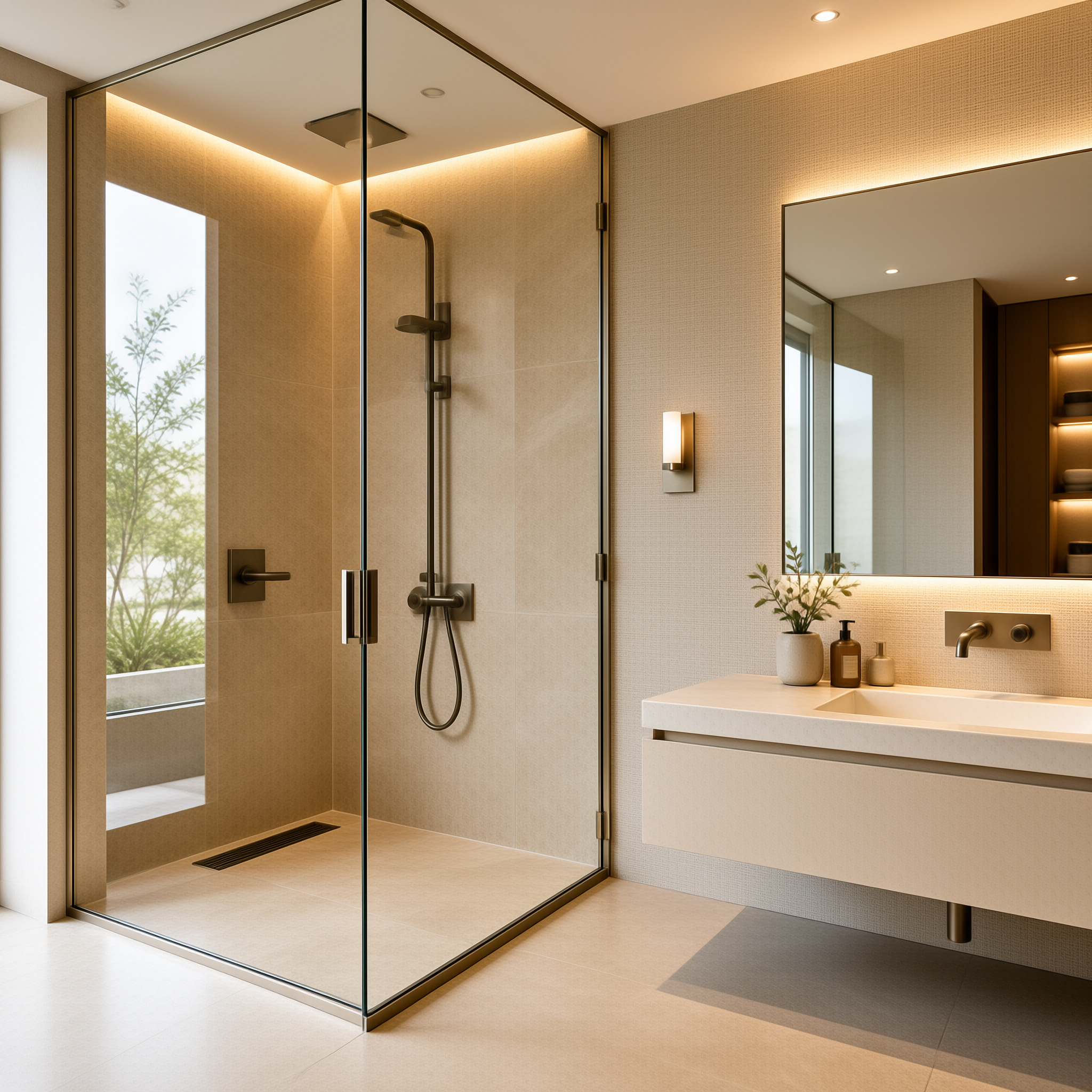
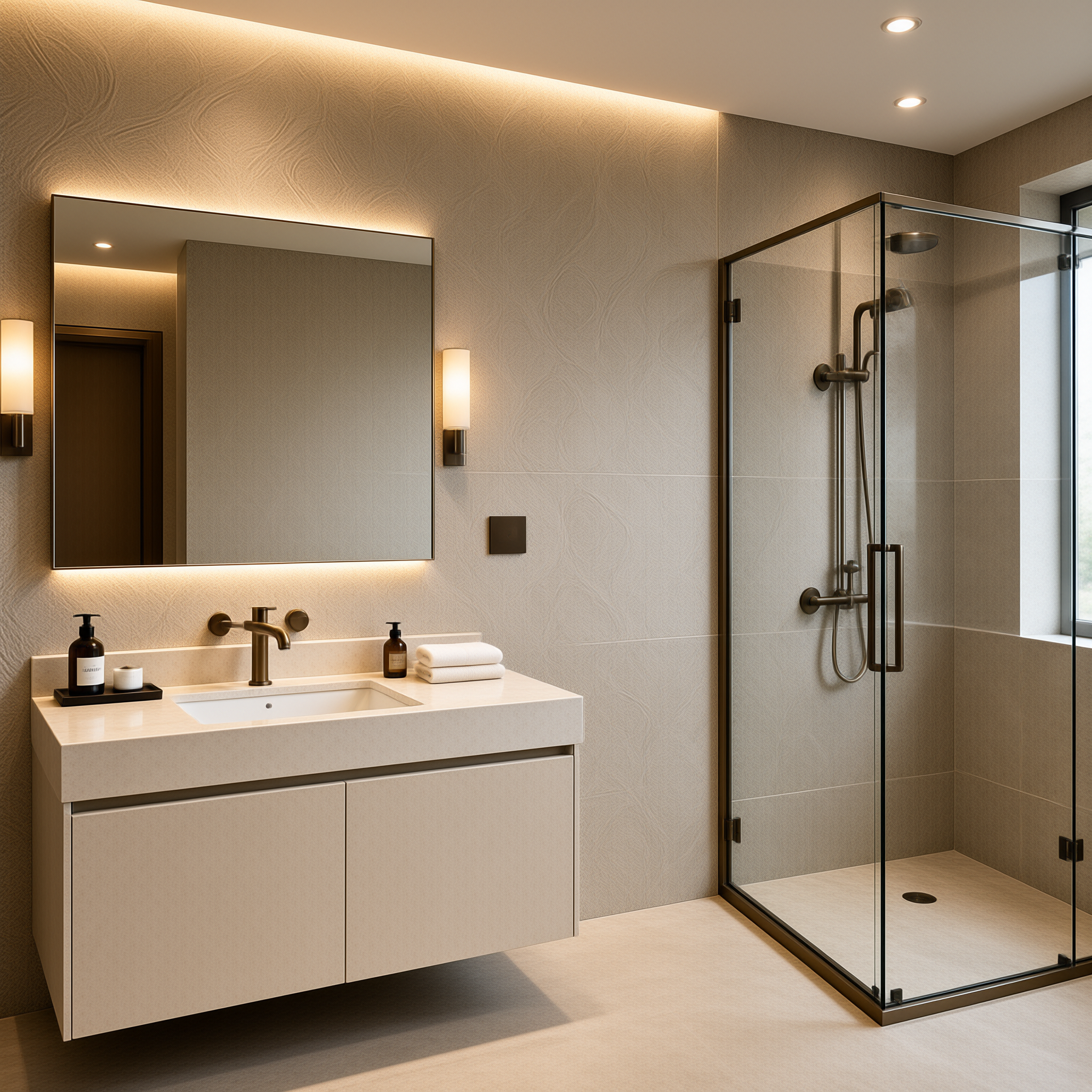
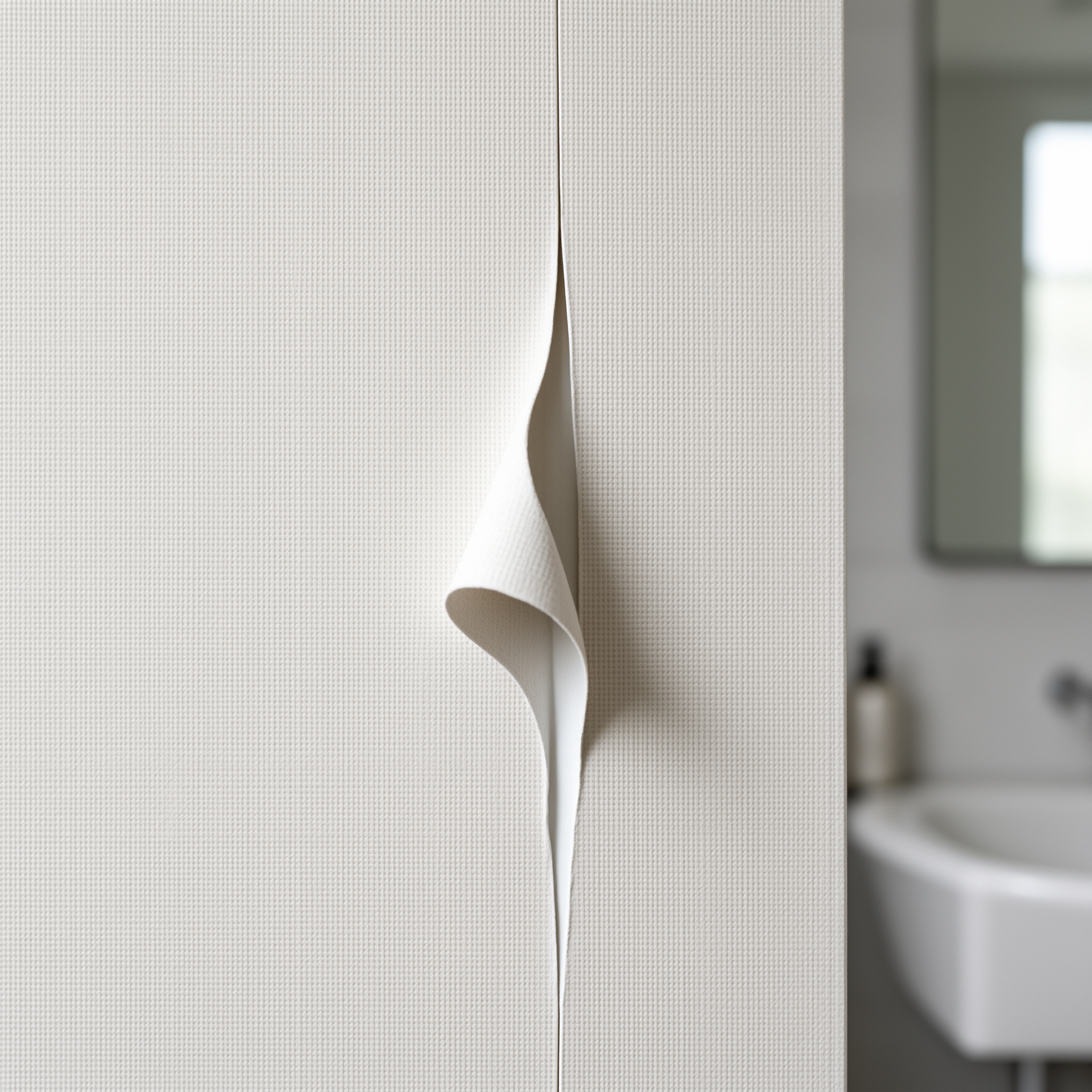
Compare vinyl vs non woven wallpaper for humid rooms — construction, moisture behavior, cleanability, installation, and zone suitability in a neutral B2B guide.
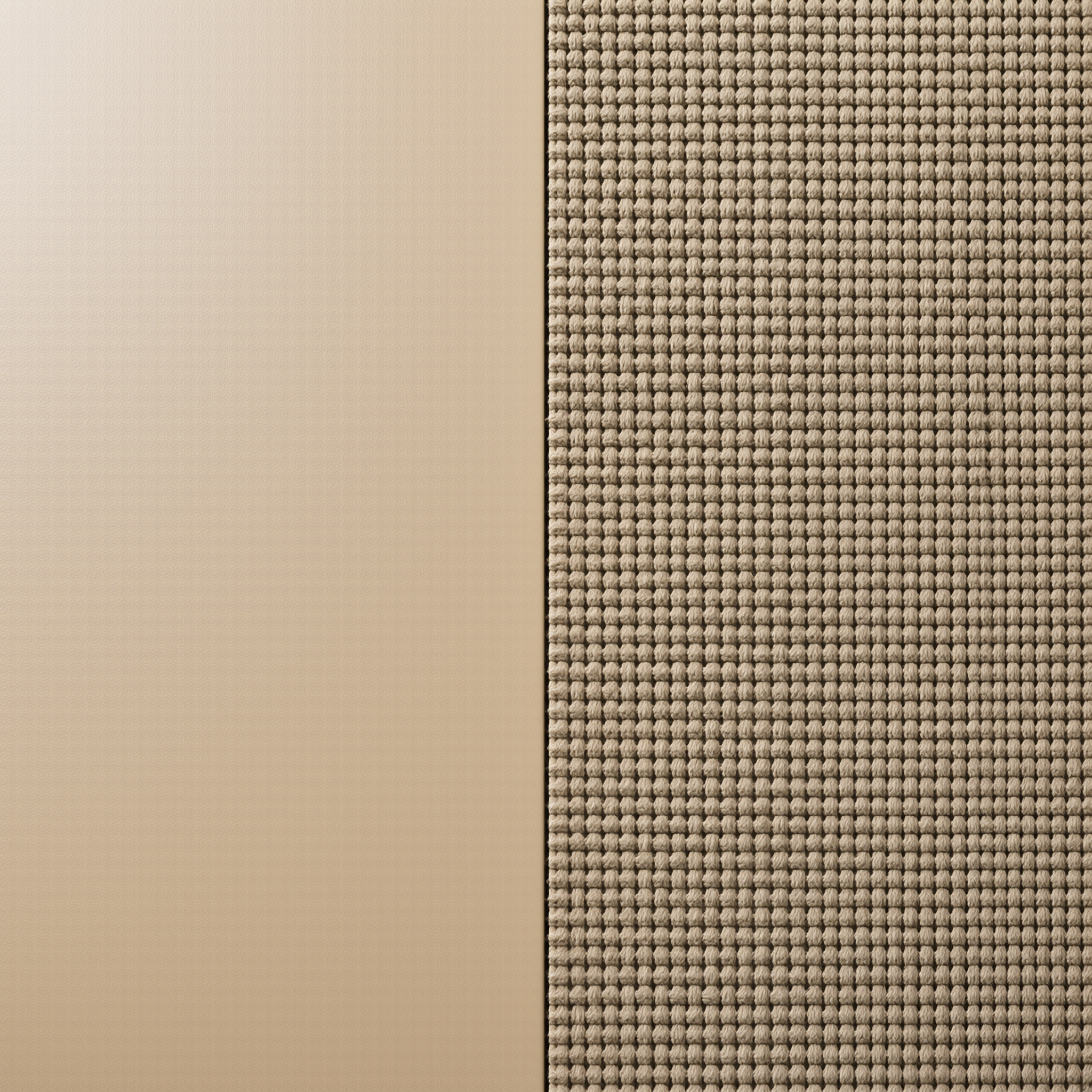
Vinyl vs non woven wallpaper comes down to two different construction logics, not a waterproof-versus-non-waterproof contest. Humid-room performance is set by the face layer, coating weight, adhesive system, and the zone where the roll is installed.
'Vinyl' usually means a PVC or vinyl-acrylic face. 'Non-woven' means a bonded fibrous backing that is often paired with a printed, coated, or embossed face. The backing type alone does not determine how the finished wallcovering will perform in humid conditions. The face construction, protective coating, adhesive system, substrate preparation and level of moisture exposure should all be considered together.
Non-woven describes a backing category, not a moisture rating for the finished wallcovering.
Key Takeaways
Neither 'vinyl' nor 'non-woven' is a moisture guarantee — the finished product's face layer, coating, and adhesive set performance.
Solid vinyl faces generally resist repeated wet cleaning better; non-woven backings generally hold seams flatter as humidity shifts.
Match the product to the bathroom zone: low splash, splash, or direct water exposure.
Scrubbability classes follow EN 259; dimensional movement of non-woven backings is tested under EN 233 / EN 234.
Manufacturer technical data sheets override category-level assumptions in every humid-room specification.
Vinyl vs Non-Woven Wallpaper: How They Actually Differ in Humid Rooms
In humid rooms, the real difference is where the moisture barrier sits. A vinyl-faced product puts the polymer film on the room side; a non-woven product leans on the backing plus whatever face the printer applied.
A continuous PVC film forms a low-transmission barrier, so surface water stays out of the substrate. A fibrous backing is porous by design, which means the printed face and any protective lacquer decide whether splashes bead or soak in.
Wallcovering performance should be checked against the technical data for the specific product rather than inferred from the category name alone. Standards such as EN 233 cover requirements for finished wallpapers, wall vinyls and plastic wallcoverings, including characteristics such as washability and marking, while EN 259-1 applies specifically to heavy-duty wallcoverings.For B2B specification, always compare the technical data sheet (TDS) of the exact wallcovering being considered.
Construction: Backing, Face, and What 'Non-Woven' Really Means
What 'Vinyl' Describes
Vinyl wallcovering takes its name from the face: a PVC or vinyl-acrylic film applied over paper, fabric, or non-woven backing. Solid vinyl carries no paper core; vinyl-on-non-woven and vinyl-on-paper are laminates.
The face film governs how the surface reacts to water, soap, and abrasion. The backing governs how the roll hangs, expands during pasting, and strips off the wall years later — which is why the same vinyl face behaves differently on paper than on a non-woven base.
What 'Non-Woven' Describes
Because non-woven backings are designed for dimensional stability, they generally show less expansion and contraction during installation than traditional paper backings. This is one reason non-woven wallcoverings are commonly used with paste-the-wall installation methods.However, dimensional stability of the backing should not be confused with moisture resistance of the finished surface.
Because the fiber web is dimensionally stable and semi-porous, it accepts paste-the-wall adhesive and resists the shrinkage that paper backings show as they dry. Non-woven backings are commonly reported below 1% dimensional change under the EN 233 / EN 234 method at 23°C and 50% RH (EN 233 / EN 234, 2024). Breathability describes the backing, not the splash resistance of the finished face.
Moisture Performance, Cleanability, and Dimensional Behavior
Vinyl bathroom wallpaper generally leads on surface moisture tolerance and scrubbability. Non-woven products generally lead on dimensional stability and seam flatness. Neither category wins on both.
A continuous PVC film has low vapor transmission and survives repeated wet wiping, so high scrub ratings cluster among vinyl-faced products. The question 'is non-woven wallpaper moisture resistant' has no category answer: the fiber backing swells less than paper when humidity shifts, but the printed face and lacquer decide splash response.
Washability, cleaning resistance and other performance characteristics should be verified using the technical data sheet for the exact wallcovering. Applicable standards vary according to the wallcovering type and intended use.For project specification, buyers should compare the declared performance of individual products rather than assuming that all vinyl or all non-woven wallcoverings share the same cleaning or moisture resistance.
Surface moisture: vinyl faces resist repeated wet wiping; lightly coated non-wovens need gentle wiping.
Seam behavior: non-woven backings hold flatter; paper-backed vinyl moves more with humidity swings.
Cleaning: match the cleaner to the TDS — solvent cleaners can dull some printed non-woven faces.
- Dimensional stability: non-woven backings generally show less expansion and contraction during installation than traditional paper backings.
Steam exposure: only products with a stated direct-water rating belong inside a shower enclosure.
Scrubbability is a face-layer property and dimensional stability is a backing property — humid rooms test both at once.
Side-by-Side: Vinyl vs Non-Woven Wallpaper Comparison Table
| Feature | Vinyl-faced wallcovering | Non-woven wallcovering |
|---|---|---|
| Face | PVC or vinyl-acrylic film or coating | Printed, coated, or embossed face on fiber backing |
| Backing | Paper, fabric, non-woven, or solid vinyl | Bonded fiber web (standard) |
| Surface moisture response | Varies with film and coating weight | Varies with face coating and lacquer |
| Scrubbability | Often classed washable to extra-scrubbable (EN 259) | Typically light-wipe to washable |
| Dimensional behavior | Depends on backing; paper-core grades move more | Low movement commonly reported (EN 233 / EN 234) |
| Installation method | Paste-the-wall or paste-the-product per TDS | Usually paste-the-wall |
| Seam appearance | Embossed faces hide seams; smooth faces show them | Tight seams typical on stable backings |
| Removal | Depends on backing type and adhesive used | Often strippable when the TDS specifies it |
| Paintability | Generally not paintable | Some are paintable if the face allows |
| Best-fit zones | Splash and high-touch areas when the product is rated | Low-splash areas with an appropriate specification |
| The table above is a starting filter, not a specification. Two vinyl products on different backings can sit at opposite ends of the same row, and a coated non-woven can outperform a thin vinyl in a low-splash zone. |
Bathroom wallcovering material selection works on three linked variables: how much water reaches the wall, how aggressive the cleaning protocol is, and how well the adhesive bonds to the substrate. The category name only helps you start narrowing the list.
Manufacturers publish these variables as scrubbability class, washability, and adhesive recommendation. Any row in a comparison matrix that lacks a TDS reference behind it is an assumption, not data (EN 259 classification, 2024).
Installation, Adhesive Compatibility, and Substrate Requirements
Failures in wallpaper for humid rooms cluster into three patterns: seam lifting, edge curl, and local blistering above the splash line. Full-panel delamination is rarer than most buyers expect.
Vapor migrates through the plaster or drywall and condenses behind the wallcovering when the wall runs cold or the adhesive is still curing. The seam gives way first because the film is already discontinuous there, and non-woven wallpaper bathroom peel usually traces to over-thinned adhesive or an unprimed porous wall rather than the backing itself.
Adhesive compatibility should be checked for the exact wallcovering, primer and substrate combination. Absorbent plaster, sealed drywall, painted surfaces and other substrates can require different preparation methods or adhesive systems.For commercial projects, review the wallcovering manufacturer's installation instructions and adhesive recommendations before specification. Where the substrate or environmental conditions are unusual, a small on-site adhesion test can help identify compatibility issues before full installation.
Suitability by Bathroom Zone and by Project Type
Match the bathroom wallcovering material to the zone, not to the category. Low-splash areas tolerate coated non-woven; splash zones need a scrubbable face; direct-water zones inside a shower are a tiling or panel decision.
Residential Bathrooms
In a home bathroom, a coated non-woven in the dry vanity area and a scrubbable vinyl-faced product in the splash zone around the basin is usually the right split. Choose based on the cleaning routine you will actually keep.
A common mistake is choosing material by look alone and skipping a washability check. A matte, lightly coated non-woven that reads beautifully in a showroom can stain permanently after two winters of splashing.
Hotel and Commercial Bathrooms
Hotel guest bathrooms usually justify a solid-vinyl or vinyl-on-non-woven face in the splash zone, because housekeeping applies stronger chemistry on a fixed cycle. Back-of-house and spa corridors with low splash can carry coated non-woven.
Treat 'vinyl wallpaper steam shower' as a product-specific question. Ask for the manufacturer's direct-water rating and the recommended sealant detail rather than assuming the category answers it.
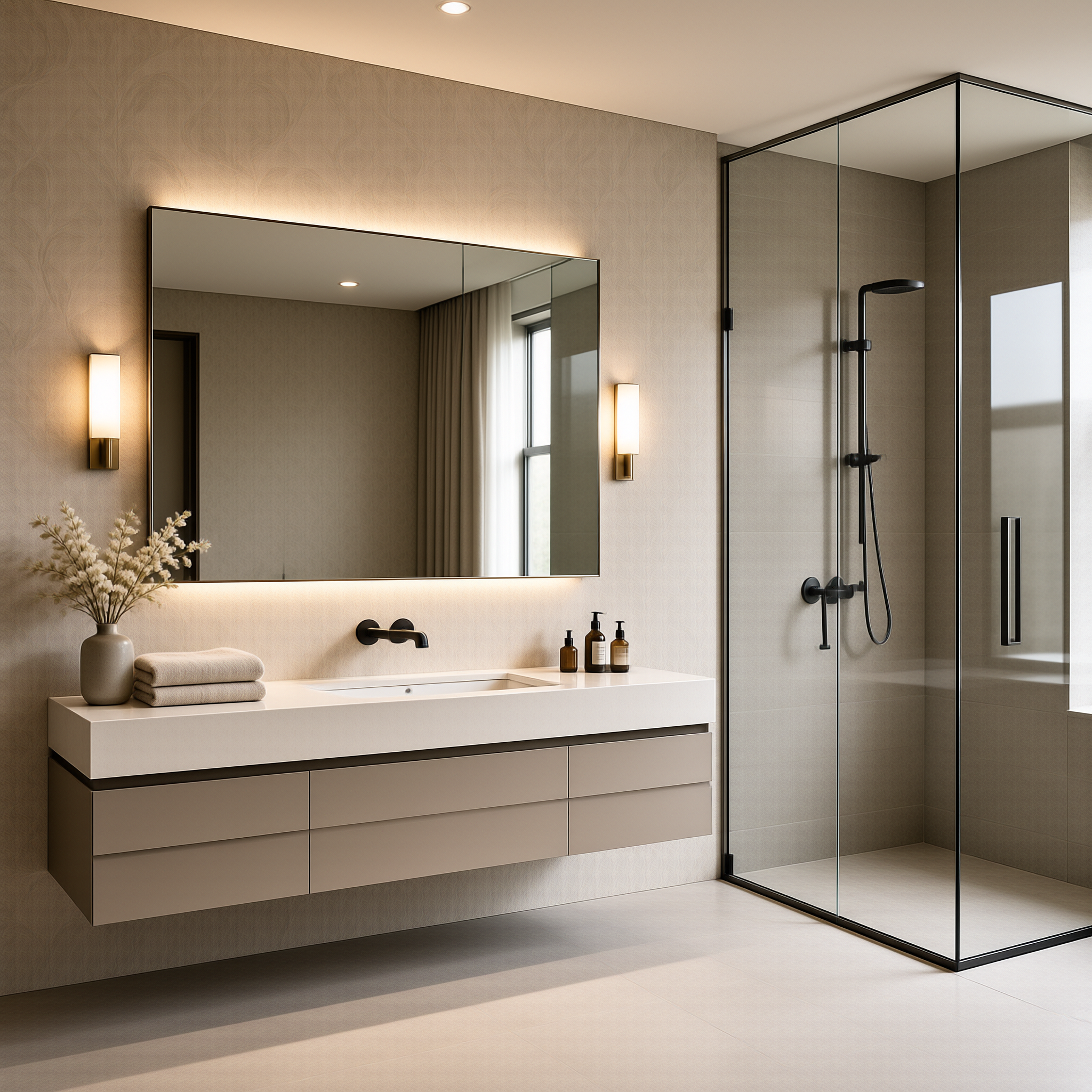
For hotel and hospitality projects, material selection should be based on the exposure level of each zone rather than applying one wallcovering specification throughout the entire project.Guest bathrooms, vanity areas, corridors and other spaces may have very different moisture exposure and cleaning requirements. Matching the wallcovering construction to each zone can help reduce maintenance and replacement problems over the life of the project.
Choosing Between Vinyl and Non-Woven: Decision Framework
Choose a vinyl-faced product when the zone sees regular splashing and the cleaning protocol is aggressive. Choose a coated non-woven when the zone stays dry, seams must stay invisible, and the roll may be repainted later.
The decision hinges on exposure and refurbishment cycle. Where cleaning happens daily with alkaline or solvent products, a scrubbable face extends service life. Where the wall is repainted every five to seven years, a paintable non-woven avoids a full strip-out.
For hotel refurbishment projects, the lowest material price does not always produce the lowest installed cost. A wallcovering that is poorly matched to moisture exposure or cleaning requirements may require earlier maintenance or replacement.For this reason, project buyers should compare lifecycle suitability as well as the initial roll price. Specify the wallcovering by zone, expected cleaning frequency and replacement cycle.
Choose a scrubbable vinyl face if the wall sits within splash distance of a basin, shower, or spa pool.
Choose a coated non-woven if the zone is low-splash, seams must disappear, and repainting is planned.
Choose neither for the inside of a shower enclosure — use tile, panel, or a product with a stated direct-water rating.
Request the TDS for the exact SKU before pricing, not the category brochure.
Sample-test the adhesive on the actual substrate; primers change bond strength on sealed walls.
Zone, cleaning protocol, and refurbishment cycle decide vinyl versus non-woven — not the category label.
FAQ: Vinyl and Non-Woven Wallpaper in Humid Rooms
- Is non-woven wallpaper moisture resistant?
- Non-woven is a backing category, not a moisture guarantee. Resistance depends on the face layer, coating, and lacquer specified in the product's technical data sheet.
- Is vinyl wallpaper always waterproof?
- No. Solid vinyl faces are generally more moisture-tolerant, but performance varies by film, backing, and coating. Check the manufacturer's specification rather than the category label.
- Can non-woven wallpaper be used in a bathroom?
- Yes, in low-splash zones with a product specified for humid interiors. Direct-splash zones need a face with a stated washability or scrubbability rating.
- Which is easier to install in a humid room?
- Non-woven paste-the-wall installation is usually simpler and more forgiving. Vinyl often needs the adhesive named by the manufacturer plus careful seam rolling.
- Which is easier to remove during renovation?
- Most non-woven products are strippable when the TDS says so. Vinyl removal depends on the backing type and the adhesive that was used.
- Can you paint over non-woven wallpaper?
- Often yes, if the face layer is designed for overpainting. Vinyl-faced wallcoverings are generally not paintable and should be removed instead.
- Which is better for hotel or commercial bathrooms?
- Neither by default. Decide by traffic, cleaning chemistry, and refurbishment cycle, then match the specific SKU to the zone.
The short version: vinyl vs non woven wallpaper is a specification question, not a category verdict. Start with the zone, the cleaning protocol, and the refurbishment cycle, then verify each candidate against its technical data sheet. The ISO and ASTM test methods referenced above give you a neutral language for comparing those sheets line by line.