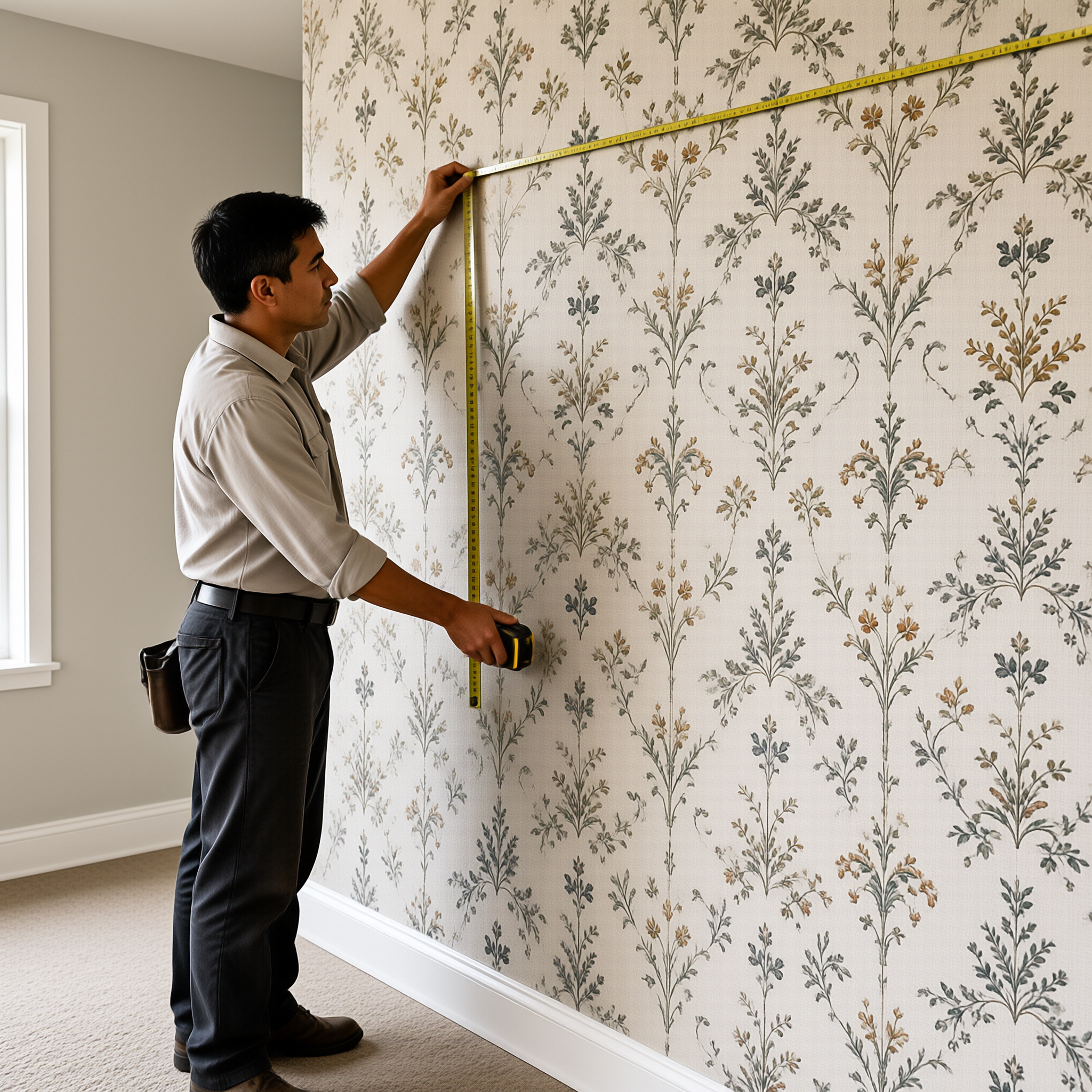
Wallcovering roll sizes do not set order quantity. Compare usable coverage, pattern repeat, matching methods, cutting waste and the inputs a supplier needs to quote.
Wallcovering roll sizes describe the physical format of the material you receive, not the quantity your project needs. Confirm roll width and length, gross area, usable coverage after trimming, pattern repeat, matching method, room dimensions, openings, and the supplier's packing rules before you order.
Identical nominal roll area can produce different order quantities. A matched, offset, or free layout changes how efficiently strips come off each length, and how much of that length is committed to alignment instead of wall.
Two walls of equal area can need different roll counts, because pattern repeat — not surface area — sets how each strip is cut.
Key Takeaways
A 0.53 m × 10.05 m roll equals 5.33 m² gross, but trimming and matching reduce installed coverage below that figure.
Straight and offset matches lock cut lengths to repeat multiples; free match removes that constraint, not the installation risk.
Order quantity follows strip count, not wall area divided by roll area — the two methods can differ by a full roll.
Custom-sized panels cut offcuts only when measurements are frozen and the panel sequence is confirmed before production.
No universal waste percentage is reliable; validate any allowance against an approved, dimensioned cutting plan.
Wallcovering Roll Sizes: The Dimensions Buyers Need to Confirm
Roll dimensions are product-specific, not category-wide. Width and length vary with substrate, coating line, and market convention, so no single format can be assumed across suppliers.
Manufacturers trim a running web to a finished width after selvedge removal, and that trimmed edge sets the usable roll width. Length is fixed at the winding and packing step. Both figures belong to a specific product line, not to wallcovering as a class.
Request four fields on the technical data sheet before comparing prices: trimmed width, roll length, vertical repeat, and horizontal repeat, each with a stated tolerance. A sheet quoting only a nominal size is a marketing line, not a specification.
Roll Area Is Not Usable Coverage
Gross roll area is roll width multiplied by roll length. Usable coverage is always smaller, and that gap is where most quantity errors begin.
Each drop is cut longer than the finished wall height so the motif can be positioned, and the trimmed remainder rarely fits the next drop. Corners, ceiling lines, and skirting edges absorb additional material that never reaches a visible surface.
Take a hypothetical 0.53 m × 10.05 m roll: gross area is 5.3265 m². Cut into matched drops of 3.12 m for a 2.7 m wall, three drops fit per roll and deliver about 4.29 m² of installed coverage — roughly 81% of gross.
Pattern Repeat and Matching Methods Compared
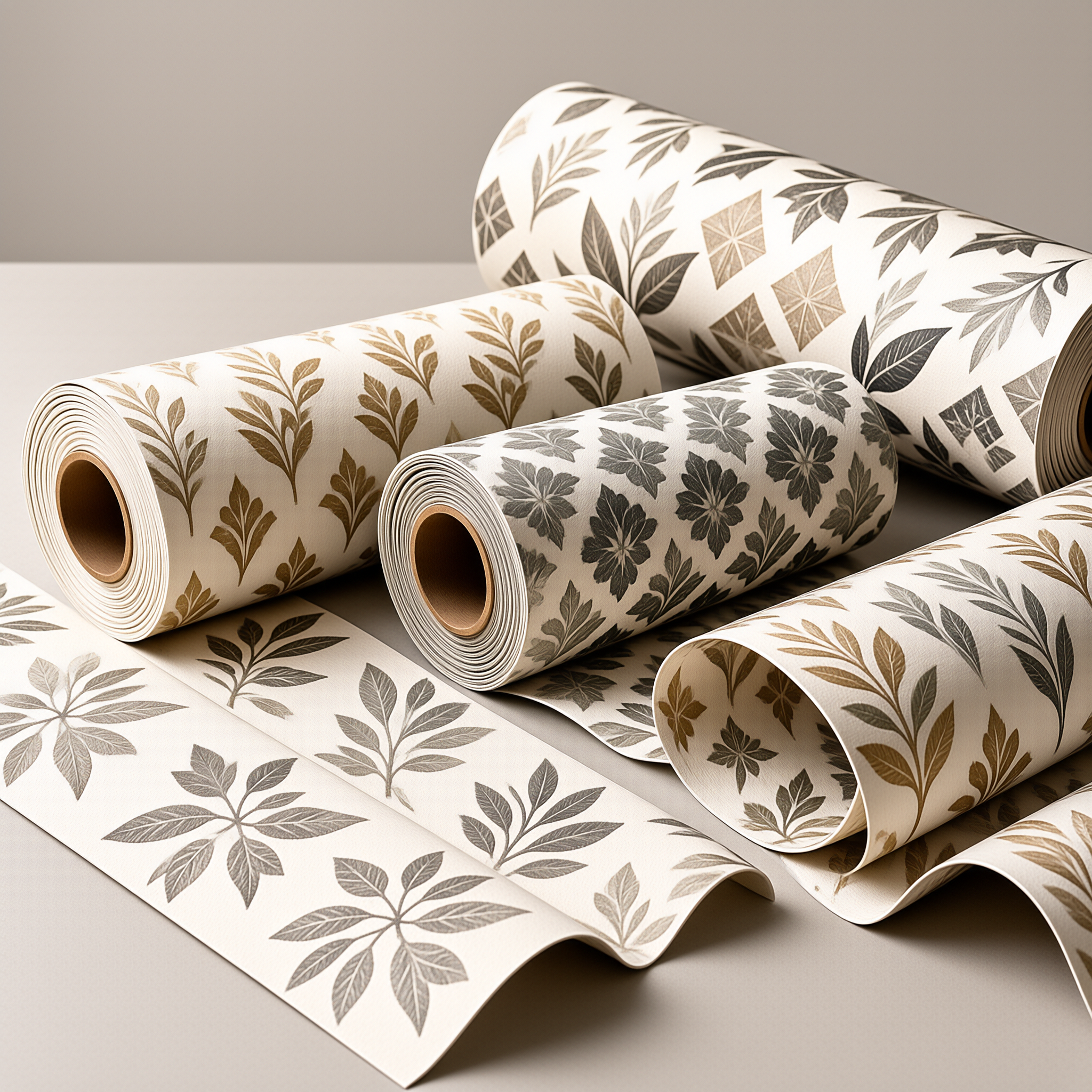
Matching methods define how adjacent strips align. Straight match aligns motifs at the same height, offset match staggers alternate strips, and free match requires no alignment at all.
Registration drives the difference, and the wallpaper pattern repeat is the governing number. When motifs must line up, each cut length is forced to a whole multiple of the vertical repeat. The leftover tail then has no valid position on that wall.
With a hypothetical 0.52 m vertical repeat on a 2.7 m wall, six repeats give a 3.12 m cut — 0.42 m above wall height. That surplus is repeated on every strip rather than shared across the room.
| Matching method | Alignment rule | Cut length driver | Effect on usable coverage |
|---|---|---|---|
| Straight match | Motif aligns at the same height on every drop | Whole multiple of the vertical repeat | Highest constraint; every drop carries the same tail |
| Offset (half-drop) | Motif shifts by half the repeat on alternate drops | Repeat multiple plus half repeat on alternate drops | Moderate; two drop types must be planned and sequenced |
| Free match | No alignment required between strips | Wall height plus trim allowance | Lowest constraint; loss depends mainly on trim and corners |
Straight Match
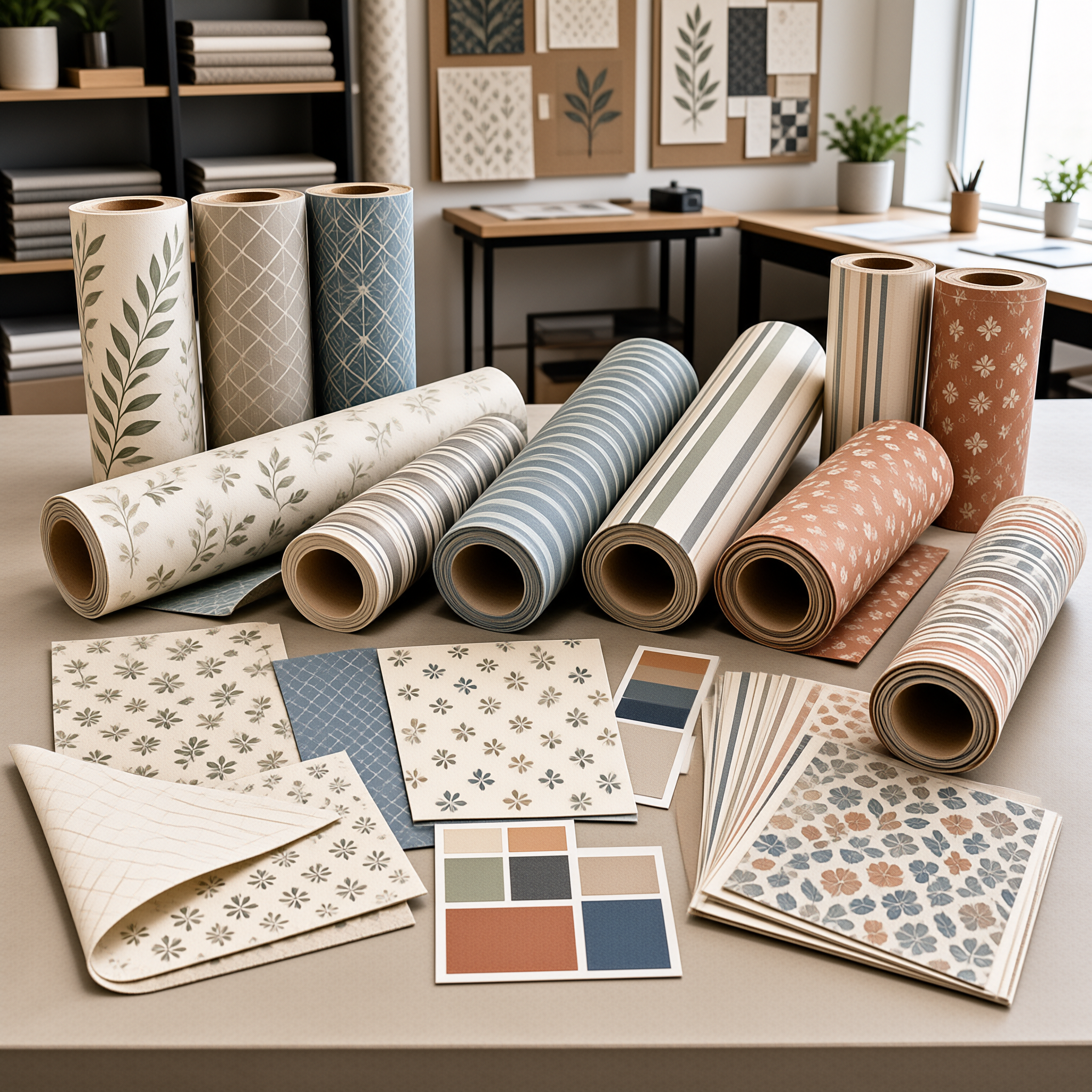
Straight match is the strictest layout. Every strip must be cut from the same point in the repeat, so all drops share one cut length wherever they land on the wall.
Its practical cost is repetition. A short wall still pays the full repeat tail on every drop, and one unplanned extra drop usually means one extra roll.
Offset Match
Offset match, also called half-drop, shifts alternate strips by half the repeat. You produce two drop types instead of one, and they must be installed in sequence.
This layout handles a repeat that is large relative to wall height better than a straight match does. It fails quickly when strips go up out of order, so label drops before cutting.
Free Match
Free match removes alignment entirely. Each strip is cut to wall height plus trim, and leftover tails can be reused on shorter walls or above openings.
Free match wallpaper suits irregular rooms best, but it is not a licence to skip layout planning. Motif direction, seam placement, and light reflection still need a decision before cutting.
Hypothetical Order Calculation: From Gross Area to Material Needed
Order quantity comes from counting strips and from roll yield per strip. Wall area divided by roll area is only a cross-check, and it usually understates the answer.
A roll is a linear supply of fixed length, not a divisible area. What matters is how many complete drops of the required cut length fit end to end along that length. Any tail shorter than the cut length becomes cutting waste on that wall.
All figures below are hypothetical and show method only. The example uses a 12.0 m wall, 2.7 m ceiling, no openings, a 0.53 m × 10.05 m roll, and a 0.52 m straight repeat. Gross wall area is 32.4 m² and gross roll area is 5.3265 m².
Strip count: 12.0 m ÷ 0.53 m = 22.6, rounded up to 23 strips.
Cut length per drop: 6 repeats × 0.52 m = 3.12 m, covering 2.7 m plus trim allowance.
Yield per roll: 10.05 m ÷ 3.12 m = 3 complete drops, leaving a 0.69 m tail.
Roll count: 23 strips ÷ 3 drops per roll = 7.67, rounded up to 8 rolls.
Area cross-check: 32.4 m² plus a hypothetical 10% wallpaper wastage allowance = 35.64 m² ÷ 5.3265 m² = 6.69, rounded to 7 rolls.
The 10% figure is an illustrative planning assumption, not a recommended rate for any project.
The final count still needs supplier confirmation against the real product specification.
Area math suggested 7 rolls on this hypothetical wall; counting matched drops gave 8 — the gap is one full roll of cutting waste.
Standard Rolls Versus Custom-Sized Panels
Standard rolls win on availability and price per square metre. Custom-sized panels win on material utilization when room geometry repeats and dimensions are already frozen. The tradeoff is flexibility versus offcut volume.
A panel is produced to a specified drop length and sequence, so the repeat tail is trimmed at the factory instead of on site. That removes cutting labour and offcut handling, but it turns a stock item into a made-to-order run with its own lead time and error exposure.
On the hypothetical 12.0 m wall, eight standard rolls supply 24 drops against 23 required — one spare drop. A panel run of 23 pre-trimmed drops removes about 8.6 m of on-site offcut, yet any measuring error has no spare to absorb it. Straight match wallpaper makes this comparison clean, because both formats are then quoted in identical drop lengths.
| Factor | Standard rolls | Custom-sized panels |
|---|---|---|
| Ordering basis | Whole rolls | Panel count at fixed drop length |
| Offcut location | On site, cut drop by drop | Trimmed during production |
| Tolerance to measurement error | Absorbed by spare material | Low; errors disrupt the panel sequence |
| Lead time | Stock-dependent | Production run plus artwork and panel approval |
| Best fit | Irregular rooms, phased installation | Repeating room modules, frozen dimensions |
How to Prepare an Accurate Wallcovering Quotation
An accurate quotation needs five inputs: measured elevations, an opening schedule, a product specification with repeat, a matching method, and delivery constraints.
Estimators price from a cutting plan, not from a wish. When elevations arrive as a square-metre total, someone must assume a strip layout, and that assumption becomes commercial risk for whichever party carries it.
In a structured quote review across 6 hypothetical sample rooms, we recommend one room sheet per elevation. It records width, full-height length, openings, required starting point, and planned panel sequence, with each dimension cross-checked against 2 independent measurement sources.
Site and Surface Information
Record wall width and floor-to-ceiling height for every elevation, measured at two or three points. Note the widest and narrowest reading, because out-of-square walls change strip count more often than total area does.
List every opening with its position and dimensions, then describe the substrate: plaster, drywall, lining paper, or an existing covering. Preparation and adhesion requirements belong in the quotation, not in a later variation order.
Product and Matching Information
Name the product and give its trimmed width, roll length, vertical repeat, horizontal repeat, and required matching method. Where the layout is offset match wallpaper, state the half-drop value in writing instead of leaving it implied.
Add the required starting point: a focal wall, a corner, or a centred motif. The starting point fixes the panel sequence and the trim allowance at both ends of the wall.
Commercial and Delivery Information
State the required delivery date, site access limits, and whether phased deliveries are acceptable. Phasing changes how much spare material must be held on site between stages.
Ask the supplier to confirm the overage policy in writing: whether extra material sits inside the quoted quantity, whether unopened rolls are returnable, and how batch shade variation is handled.
Elevation schedule with width, height, and measurement points
Opening schedule with positions and dimensions
Substrate description and preparation requirements
Product specification: trimmed width, roll length, repeat, and matching method
Starting point and proposed panel sequence
Delivery date, site access constraints, and phase plan
Common Ordering Mistakes and Their Causes
The most expensive ordering mistakes are not pricing errors. They are quantity errors that appear only when the installer opens the last roll.
Quantity errors compound because each assumption hides inside the next. Gross area replaces usable coverage, usable coverage replaces strip count, and strip count replaces roll yield. Every substitution looks reasonable, and each one moves the final number.
In a hypothetical order review covering 10 room elevations, the reviewed quantity changed once a strip plan was built. Three elevations needed a different starting alignment, and 2 elevations included openings that the gross-area estimate had ignored.
Ordering from total wall area with no strip plan behind it
Using a flat wallpaper wastage percentage instead of counting drops
Ignoring the starting point until the panel sequence runs the wrong way
Assuming every roll in a shipment shares one shade
Discounting openings because they roughly cancel the trim allowance
A quantity error is invisible at order stage and unavoidable at installation stage.
Frequently Asked Questions
- Can I determine roll quantity from total wall area alone?
- No. Wallcovering roll sizes describe the supply format only. Area ignores strip count, repeat, matching method, openings, and roll yield, and the two methods can differ by a full roll.
- Is straight match harder to install than free match?
- Yes. Straight match requires every drop to align at the same repeat point, so a misplaced cut cannot be corrected. Free match removes that alignment requirement from installation.
- Does a larger repeat always mean more waste?
- Not automatically. A larger repeat constrains cut length, but actual loss depends on wall height, strip count, and whether leftover tails can be reused on shorter walls.
- Should I order custom panels or standard rolls?
- Choose custom panels when room dimensions repeat and measurements are frozen. Choose standard rolls when the site is irregular, phased, or still being measured.
- What single figure should I confirm before ordering?
- Confirm the cut length per drop, then confirm the roll length it must divide into. Those two figures decide how many rolls your strips actually consume.
Roll width, roll length, repeat, and matching method are the four numbers that decide a wallcovering order — everything else is arithmetic.
Ordering accurately comes down to one habit: convert every wall into drops before converting drops into rolls. For a like-for-like comparison of wallcovering roll sizes across suppliers, request trimmed width, roll length, repeat, and matching method in writing, then ask for a quotation built on a dimensioned strip plan rather than a square-metre total. That input pack is what keeps a quoted quantity and an installed quantity in agreement.