Compare commercial wallcovering vs residential wallpaper by use, traffic, cleaning, materials and procurement, with hotel, office and home examples.
Commercial wallcovering vs residential wallpaper comes down to intended use and project demands: contract products are commonly considered for shared, high-traffic and intensively cleaned spaces, while residential wallpaper is usually specified for lower-traffic living environments.
Neither label guarantees performance. The material, backing, coating, adhesive system, installation method, cleaning regime and site conditions decide whether a finish holds up.
A category label does not prove suitability; the exact product, substrate and cleaning regime decide how a wall finish performs.
Key Takeaways
Contract wallcovering suits shared, high-traffic interiors; residential wallpaper fits lower-traffic rooms — but product data decides approval.
Define the cleaning regime before choosing a finish, because cleaning intensity changes the required construction.
Hotel corridors need documented construction, roll continuity and an agreed installation sequence, not just a good-looking sample.
Wall preparation and installation method can matter as much as the wallcovering category itself.
Always request the exact candidate product, its care instructions and its sample — never a category description.
Commercial Wallcovering vs Residential Wallpaper: Which Fits the Project?
The short answer: match the product to the wall, not the label to the room type. Commercial wallcovering is a specification route for contract interiors; residential wallpaper is a retail category for private interiors with lighter contact.
Wall wear comes from contact, moisture and cleaning cycles, so the construction beneath the printed surface does most of the work. Base material, coating thickness, backing stability and adhesive compatibility set how a finish responds to abrasion, damp wiping and repeated cleaning.
The same vinyl-faced construction is sold through both channels, and paper-based designs appear in quiet hotel areas with limited contact. That overlap is why procurement teams compare data sheets field by field, the structured approach described in Google Search Central guidance for comparison content.

Intended Use, Traffic and Cleaning Demands
Shared and High-Traffic Interiors
Shared interiors concentrate contact. Luggage, trolleys, chairs, cleaning equipment and hands all reach the wall, which is why commercial wallcovering specifications usually target those zones first.
Wall areas near door frames, corners and service corridors take the most punishment, so buyers often specify different products inside one property. A corridor wall and a decorative feature wall rarely need the same construction.
Residential Traffic Patterns
Residential rooms see fewer contacts per day. Most wear comes from furniture, cleaning and occasional impact rather than continuous footfall.
Rooms with children, pets, kitchens or high humidity still shift the brief. In those cases the cleaning routine and substrate condition matter far more than the room's residential label.
Cleaning and Maintenance Regimes
Cleaning intensity is the most useful question in this comparison. A wall wiped daily with a damp cloth needs a different finish from one dusted twice a year.
Ask for written care instructions for the exact product, then check the building's cleaning chemicals and methods against them. Where cleaning is frequent or chemical-heavy, confirm compatibility before approval rather than after installation.
| Dimension | Shared-space / contract wallcovering | Residential wallpaper |
|---|---|---|
| Intended use | Hotels, offices, retail, corridors and other shared interiors | Private homes and low-contact rooms |
| Expected traffic | High footfall and repeated contact near doors, corners and service areas | Household traffic; contact mainly from furniture and cleaning |
| Cleaning | Routine spot cleaning plus periodic wash-down, per supplier instructions | Mostly dry dusting with occasional gentle spot cleaning |
| Material emphasis | Construction, backing, coating and adhesive chosen for the wall's demands | Surface design, texture and budget usually lead the decision |
| Technical review | Substrate survey, seam plan, installation sequence and product-specific documentation requested | Wall condition, adhesive type and pattern matching |
| Procurement | Project quantities, sample approvals, roll consistency and replacement allowance | Room-based quantities, single purchase, limited spare material |
| Replacement | Coordinated replacement across zones; visual continuity matters | Localised repair is usually acceptable |
Materials, Construction and Technical Requirements
Materials overlap between the two categories, so the useful comparison is construction detail rather than material name. Paper, vinyl-faced, non-woven, textile and engineered builds all appear in contract ranges and residential wallpaper collections.
Coating and backing determine how a wall responds to moisture, abrasion and stripping. A heavier coating spreads cleaning stress across a wider surface, while a dimensionally stable backing keeps seams closed when the wall moves.
Check which standards are cited for the product and the market where it will be installed; the ISO standards for wallcoverings framework is a starting reference alongside local building requirements. Request documentation for the exact item, never for the whole range.
Price reflects appearance and brand as much as construction; ask what the coating, backing and installation method are before comparing two quotes.
How to Choose Wallcovering for Hotels, Offices and Homes
Three criteria settle most specification debates: contact level at the wall, the cleaning method the operator will realistically use, and whether the finish must repeat across multiple zones. Score each before opening a pattern book.
Hotel Corridors and Guest Areas
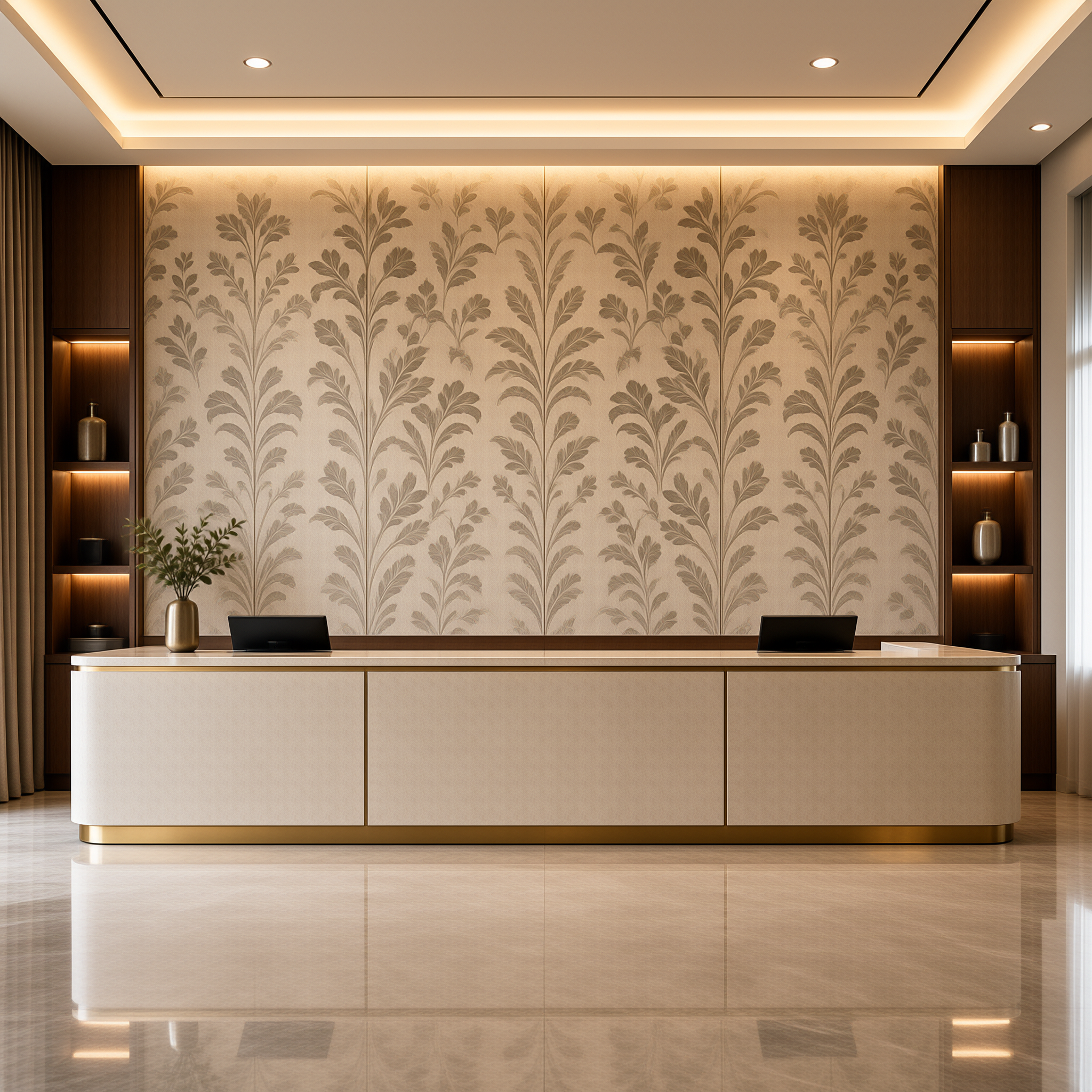
In a hotel corridor the specification burden rises quickly: luggage-cart contact, nightly cleaning, coordinated installation and later replacement of damaged drops without a visible mismatch. Commercial wallpaper for hotels should be assessed for construction, care instructions, documentation and project quantities.
A practical scenario in a VELORA project review would document 120 linear metres across 30 guest-room and corridor zones, with approvals recorded for pattern repeat, three sample rounds, substrate type, cleaning instructions and installation sequence before production release.
Offices and Shared Workspaces
Office walls wear unevenly. Desk-height zones, trolley routes, partition edges and meeting rooms take contact that a feature wall behind reception never sees.
Decide whether the finish must coordinate across open floors and meeting rooms, and confirm how often the facilities team will clean. Where partitions are relocatable, review how the wallcovering behaves at joints before approving a roll.
Residential Interior Rooms
Homes leave more room for pattern, texture and budget. Lower contact means a wider range of constructions stays workable in bedrooms and living rooms.
Kitchens, bathrooms, children's rooms and pet areas change the brief. Confirm moisture exposure, cleaning products and the wall substrate before selecting a delicate or light-coloured finish.
| Setting | Specify first | Avoid | Practical check |
|---|---|---|---|
| Hotel corridor | Construction, care instructions, roll continuity, replacement plan | Assuming the word commercial proves performance | Sample rounds and installation sequence agreed in writing |
| Office and workspace | Contact zones, partition joints, coordination across rooms | One finish used at every wall height | Cleaning frequency confirmed with the facilities team |
| Residential room | Pattern, budget, substrate condition | Ignoring kitchens, bathrooms and pet areas | Review the sample in the room's actual lighting |
Procurement Differences: Sampling, Quantities and Customization
Contract procurement is approval-driven; residential procurement is decision-driven. A B2B wallcovering supplier normally needs a written brief covering room use, dimensions, substrate, cleaning regime, documentation requirements and target schedule before quoting.
Custom work fails at handover, not at design. VELORA product-development reviews use a three-stage approval record: application and substrate intake, finish and sample review, then pre-production sign-off covering dimensions, repeat quantities, installation method and document requirements. Each stage carries an approver and a revision count so a late design change cannot reach production unrecorded.
Spare material is a commonly missed line. Contract orders often budget a replacement allowance for future repairs, while residential purchases rarely do — which becomes a problem when one wall is damaged two years later.
Why Wallcovering Performs Poorly in the Wrong Setting
Most failures appear as lifting seams, bubbling, edge wear or mismatched drops. They rarely come from the printed design.
Substrate and schedule cause most of it. Uneven, porous or damp walls defeat a good adhesive, and late changes to pattern scale, repeat, colour reference, coating requirements or the roll plan can break consistency between production runs. Freeze the approved reference and record every substitution before release.
Verify before installation: moisture at the wall, surface flatness, adhesive compatibility with the backing, and a written care instruction for the operator. The tradeoff is straightforward — an extra day of wall preparation is easier to absorb than re-hanging an occupied corridor.
Final Suitability Checklist Before Ordering
Run this review before any purchase order is raised, and keep the answers filed with the approved sample.
Room use, expected contact level and who will actually clean the wall
Substrate condition: flatness, moisture, porosity and any previous finish
Adhesive and installation method confirmed against the product data
Cleaning method and chemicals matched to the written care instructions
Pattern repeat, roll width and seam plan checked against the room dimensions
Technical documentation requested for the exact product and destination market
Replacement allowance agreed for future repairs
Approved sample signed and stored as the production reference
If any line cannot be answered, the product is not yet approved — regardless of how the sample looks on the table.
Frequently Asked Questions
- Is commercial wallcovering always more durable than residential wallpaper?
- No. Performance depends on the exact construction, coating, backing, substrate and cleaning regime, so compare the candidate product against the project conditions rather than the category name.
- Can residential wallpaper be used in a hotel or office?
- It can be acceptable in low-contact areas where cleaning is light and the wall is sound, but confirm care instructions, product documentation and a replacement plan before approval.
- What is the main difference between commercial wallcovering and residential wallpaper?
- Intended use. Contract products are specified for shared, heavily used and frequently cleaned spaces, while residential products are chosen for private rooms with lighter contact.
- What should be specified before a supplier quotes a project?
- Room use, dimensions, substrate, installation method, cleaning regime, design reference, quantities, customisation needs, documentation requirements, destination and target schedule.
- Are higher-priced wallcoverings always more suitable?
- No. Price often reflects design and brand, while construction, backing, coating, wall preparation and installation quality decide whether a finish suits the application.
Suitability is a product-level decision: match construction, cleaning and installation to the wall, not the category to the room.
Before committing a wall to a finish, send the room use, dimensions, substrate, cleaning routine and target schedule for a product-specific review — that brief is what separates a smooth installation from a costly re-hang. Buyers who want to go deeper can review the site's guides to custom decorative wallcoverings, hospitality interiors and sampling and approval workflows. The commercial wallcovering vs residential wallpaper question usually settles once the exact product, the wall and the maintenance plan are on the table.